





 English
 русский
 中文简体
中文简体Content
What Is an Elastomeric Coupling
Squeeze a block of polyurethane between two steel jaws, bolt it onto a pair of shafts, and you have the working core of an elastomeric coupling. The design looks almost too simple for industrial duty, yet these couplings routinely carry hundreds of newton-meters of torque on pumps, fans, and conveyor drives around the clock.
An elastomeric coupling connects two rotating shafts using metallic hubs on either end and a non-metallic flexible element — usually rubber or polyurethane — sandwiched between them. The elastomer does three jobs at once: it carries torque from the driving shaft to the driven shaft, it flexes to absorb small amounts of shaft misalignment, and it cushions the drivetrain against vibration and shock loading. That combination is why elastomeric designs dominate general-purpose motor-to-pump and motor-to-fan connections, where perfect shaft alignment is rarely practical and a bit of built-in forgiveness saves bearings.
How Elastomeric Couplings Transmit Torque
Torque doesn't pass through metal-to-metal contact in these couplings — it passes through the elastomer, and how it does so splits the category into two families.
Compression-loaded designs, like jaw and spider couplings, squeeze the flexible element between interlocking lugs on each hub. As the driving hub rotates, its lugs press against the spider's lobes, which in turn push against the driven hub's lugs. The element is never stretched or sheared, only compressed, which spreads stress over a larger surface and tends to extend service life.
Shear-loaded designs, such as pin-and-bushing or tire-style couplings, work the elastomer in a twisting or bending motion rather than pure compression. This geometry often permits a larger flex path and greater misalignment capacity, at the cost of somewhat lower peak torque density compared with compression types.
Most elastomeric couplings also carry a built-in safety margin: if the flexible element wears out or fails, the metal hub features on many designs make brief mechanical contact, allowing torque to keep flowing at reduced capacity long enough for a controlled shutdown rather than a sudden loss of drive.
Common Elastomeric Coupling Types
Not every elastomeric coupling looks the same, and the differences matter for selection. Three designs cover the bulk of industrial applications.
- Jaw and spider couplings use two hubs with interlocking jaws and a star-shaped elastomeric spider between them. They're compact, easy to service — the spider can be swapped without moving either shaft — and forgiving of moderate angular and parallel misalignment.
- Tire couplings replace the spider with a full rubber "tire" wrapped around both hubs. The larger flex volume gives them the widest misalignment range of the elastomeric family, along with strong electrical isolation between shafts, which matters where stray currents threaten bearings.
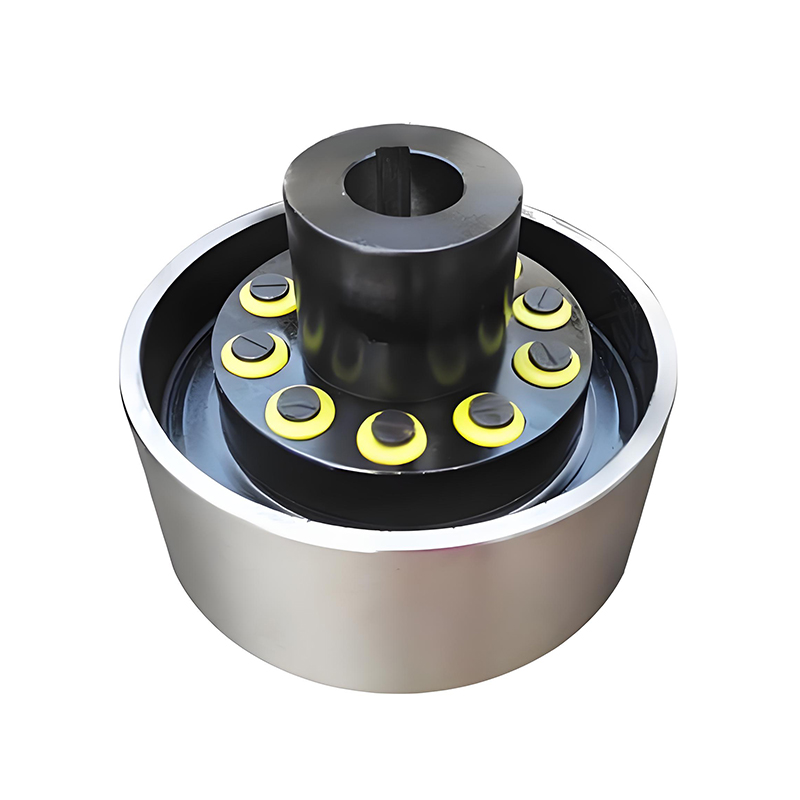
- Elastic pin (pin and bushing) couplings pass metal pins sleeved in rubber bushings through holes in two coupling flanges. The steel pins carry more of the direct load than in a pure elastomer design, which pushes torque capacity higher while keeping shock absorption intact.
| Type | Load Path | Misalignment Capacity | Typical Use |
|---|---|---|---|
| Jaw / Spider | Compression | Moderate angular & parallel | Motors, pumps, fans, conveyors |
| Tire | Shear / bending | High, including end-float | Mixers, marine drives, mills |
| Elastic Pin | Shear (pin & bushing) | Low to moderate | Cranes, heavier torque drives |
Elastomer Material and Hardness Selection
The rubber or polyurethane block is doing more engineering work than its simple shape suggests, and the material grade chosen changes how the coupling behaves under load.
Natural rubber offers strong vibration damping and performs well in cold conditions, but it has limited resistance to oils and elevated temperatures. Polyurethane trades a little damping for higher torque capacity, better wear resistance, and much better oil resistance, which is why it dominates general industrial use. Specialty elastomers such as Hytrel bridge the gap, holding their properties across a wider temperature band for demanding environments.
Within any given material, hardness is the variable that tunes performance. Softer compounds flex more easily and damp vibration better, but transmit less torque before deforming excessively; harder compounds carry more torque and hold tighter under load, at the cost of some shock absorption. Manufacturers grade this property using durometer hardness, most often on the Shore A scale, tested according to the ASTM standard for rubber indentation hardness. A softer element in the 80–85 Shore A range suits applications where cushioning matters most, while a firmer element near 95–98 Shore A suits drives that need higher torque density with less flex.
Misalignment Compensation and Vibration Damping
Shafts in the real world are never perfectly aligned, and elastomeric couplings exist largely to make that imperfection harmless.
- Angular misalignment occurs when the two shaft centerlines intersect at an angle rather than running parallel. The elastomer flexes unevenly around its circumference to absorb this without transmitting bending load into the bearings.
- Parallel misalignment happens when the shaft axes stay parallel but are offset side to side. The flexible element shears slightly to bridge the gap.
- Axial (end-float) movement results from thermal expansion or bearing clearance changes. Most elastomeric designs allow some axial slip without transmitting thrust loads back through the drivetrain.
Damping performance comes from the same flexibility. As torque fluctuates — from motor start-up spikes, uneven loads on a conveyor, or cyclic loading in a reciprocating pump — the elastomer stretches and relaxes slightly rather than passing every peak straight through. That smooths out torsional vibration before it reaches bearings and gearboxes, which is the main reason elastomeric couplings often outlast rigid connections in applications with variable loading.
Selecting the Right Elastomeric Coupling
Picking the wrong coupling type is a more common failure cause than picking one that's simply undersized. A short decision sequence keeps the selection grounded in the actual operating conditions.
- Calculate peak torque, including starting inrush and any shock loading, and apply a service factor (typically 1.25–2.5) appropriate to the driven equipment.
- Assess achievable alignment. If installation alignment will be approximate or shift over time, favor a design with generous misalignment capacity, such as a tire coupling, over a tighter-tolerance jaw type.
- Weigh vibration and shock exposure. Reciprocating compressors, crushers, and start-stop conveyor drives benefit from softer elastomer grades that prioritize damping.
- Check the operating environment. Oil exposure favors polyurethane over natural rubber; wide temperature swings may call for a specialty compound.
- Confirm bore, speed, and size fit against the manufacturer's rated envelope for the shortlisted coupling family.
For a broader side-by-side of elastomeric designs against rigid, gear, and diaphragm couplings, this complete guide to motor shaft coupling types walks through the full decision tree in more detail.
Maintenance and Failure Signs
Elastomeric couplings are largely maintenance-free compared with lubricated gear or grid designs, but the flexible element does wear and deserves periodic attention. During routine inspection, look for cracking or checking on the elastomer surface, visible elongation or permanent set in a compressed spider, a noticeable increase in vibration or noise from the coupling area, and any hardening or discoloration that suggests chemical or heat degradation.
The upside of the elastomeric design shows up right here: on most jaw, tire, and pin-bush couplings, the flexible element can be replaced without disturbing shaft alignment or pulling either connected machine, turning what would be a major repair on other coupling types into a routine parts swap. Explore the full range of flexible coupling designs to compare bore sizes, torque ratings, and element materials against your specific drive requirements.
 Previous