





 English
 русский
Motor couplings fail for one reason more than any other: the wrong type was selected. Not undersized, not poorly installed—wrong type. A jaw coupling on a high-speed precision servo drive introduces backlash that degrades positioning accuracy. A rigid coupling on a pump with angular misalignment becomes a bearing killer. Understanding what separates one motor shaft coupling type from another is not academic—it directly determines whether a drivetrain runs reliably for years or becomes a recurring maintenance problem.
Motors connect to driven equipment through couplings that must simultaneously transmit torque, tolerate shaft misalignment, absorb vibration, and in many cases protect the drivetrain from overload. No single design does all of this equally well. The right choice depends on four overlapping factors: torque and speed requirements, alignment quality achievable at installation, the presence of shock loads or vibration, and whether the application demands zero backlash.
Content
- 1 Rigid Couplings: Highest Efficiency, Strictest Installation Requirements
- 2 Jaw / Spider Couplings: Reliable Flexibility for General-Purpose Drives
- 3 Diaphragm Couplings: Zero Backlash for Servo and High-Speed Applications
- 4 Bellows Couplings: Maximum Misalignment Compensation at Zero Backlash
- 5 Oldham (Cross-Slider) Couplings: Parallel Offset Specialists
- 6 Gear Couplings: Heavy-Duty Torque with Misalignment Tolerance
- 7 Flexible Element Couplings: Tire, Jaw-Pin, Chain, and Serpentine Spring
- 8 How to Choose the Right Motor Shaft Coupling Type
Rigid Couplings: Highest Efficiency, Strictest Installation Requirements
When two shafts are perfectly aligned and will remain so throughout operation, a rigid coupling is the highest-performing option available. It creates a mechanically fixed connection with no compliance, no energy loss through flexing, and no wear elements. Torque transfer efficiency approaches 100%.
The strict requirement is perfect alignment—parallel offset below 0.05 mm and angular error typically under 0.05°. Any deviation beyond this gets transmitted directly to motor and driven-equipment bearings as additional radial load, accelerating wear. Rigid couplings are the correct choice for vertical pump drives, machine tool spindles, precision positioning systems, and any setup where laser alignment is performed during installation and regularly verified.
They are not appropriate where thermal growth, frame flexure, or vibration will cause shafts to move relative to each other after installation. In those environments, a flexible coupling type is required.
Jaw / Spider Couplings: Reliable Flexibility for General-Purpose Drives
Among the most widely used coupling types across industrial automation, pumps, fans, and conveyor drives. A jaw coupling consists of two metal hubs with interlocking jaws, separated by a polyurethane or rubber spider insert. The spider element absorbs vibration, accommodates angular misalignment up to 1°, and provides a degree of overload protection by being the sacrificial element if torque spikes occur.
The spider material selection matters significantly. Polyurethane spiders offer higher torque capacity and better oil resistance. Rubber spiders provide greater vibration damping and work better in low-temperature environments. Hytrel spiders bridge both requirements at elevated operating temperatures.
One limitation: the spider introduces a small amount of backlash, typically 0.5° to 1.5° depending on wear state. This makes jaw couplings unsuitable for servo positioning systems where bidirectional accuracy is critical. For those applications, diaphragm or bellows types are the appropriate choice. Our high-rigidity aluminum alloy jaw spider couplings are optimized for industrial automation where robustness and easy spider replacement matter most.
Diaphragm Couplings: Zero Backlash for Servo and High-Speed Applications
Diaphragm couplings use one or more thin metallic diaphragm elements to transmit torque while accommodating misalignment through elastic flexing of the diaphragm. The result is a coupling that is torsionally rigid—meaning it transmits torque without angular delay—but angularly and axially flexible, capable of handling misalignment without transmitting bending moments to shaft bearings.
Zero backlash and high torsional stiffness make diaphragm couplings the standard choice for servo motor drives, encoder-coupled axes, and any system where bidirectional position accuracy is non-negotiable. They require no lubrication, have no wear elements under normal operation, and operate cleanly in food processing and pharmaceutical environments where contamination from greases or rubber particles is unacceptable.
Single-diaphragm versions handle angular misalignment only. Double-diaphragm configurations add parallel offset compensation, making them suitable for longer spans between motor and driven equipment. Our aluminum alloy single and double diaphragm servo couplings cover bore ranges from small servo motors to medium-frame AC drives, with both clamping and set-screw hub configurations available.
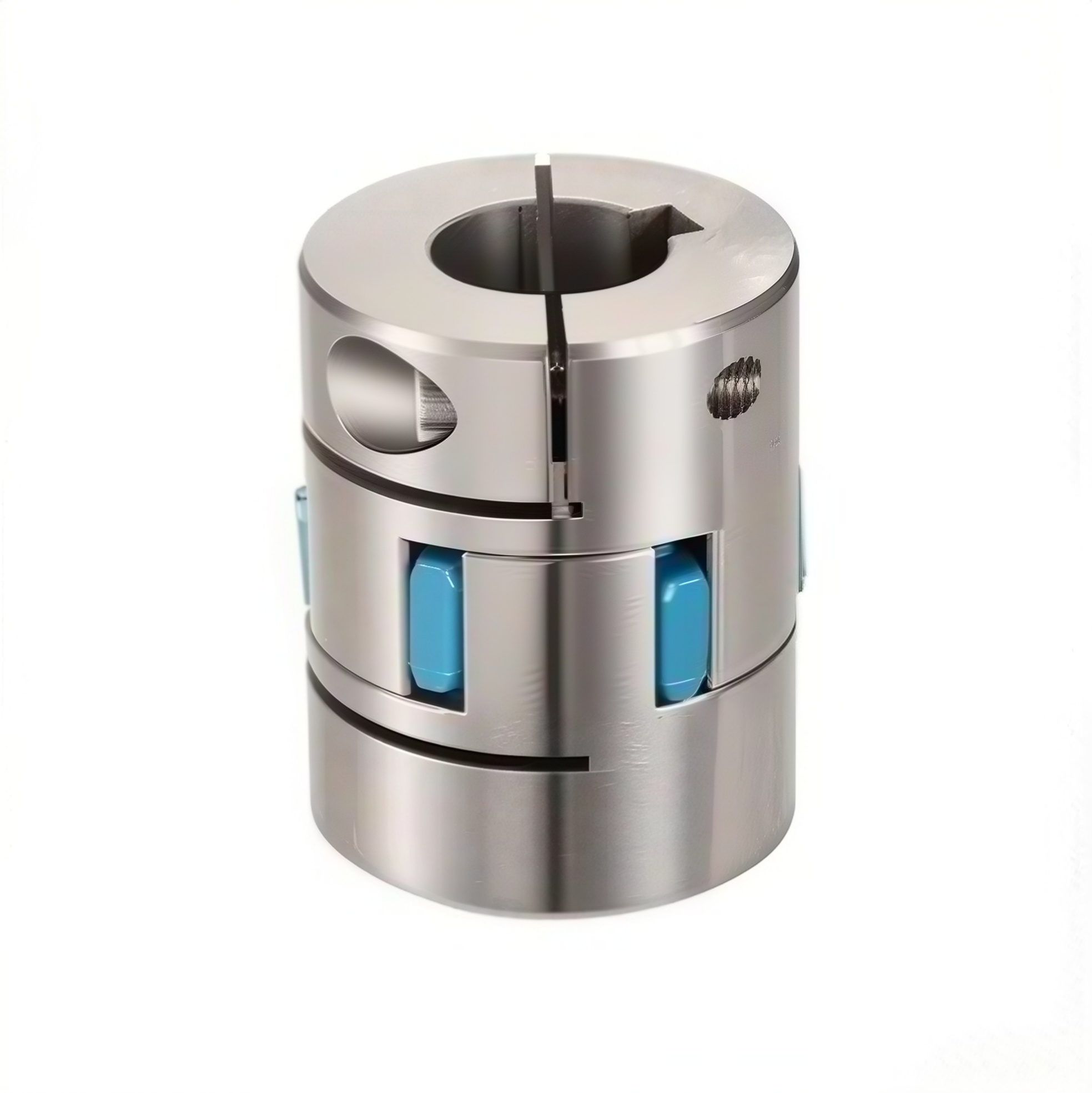
Bellows Couplings: Maximum Misalignment Compensation at Zero Backlash
Bellows couplings use a thin-wall corrugated metal bellows—typically stainless steel or aluminum—as the flexible element. The accordion-like structure can accommodate angular, parallel, and axial misalignment simultaneously, often with greater angular range than a diaphragm coupling, while still maintaining zero backlash and high torsional stiffness.
They are the preferred solution for stepper motor drives, optical encoder connections, and instrumentation applications where any rotational play would introduce measurement error. The bellows structure is sensitive to high torque shock loads, so they are not used in drivetrain segments subject to abrupt starts or reversals under load. Applications include CNC rotary axes, laser positioning systems, and laboratory automation equipment.
Aluminum alloy clamping-type bellows couplings offer the best combination of misalignment capacity and ease of installation. Stainless steel variants are selected for corrosive environments or where operating temperature exceeds the range of aluminum alloy. Our precision bellows coupling range includes both clamping and set-screw versions in aluminum alloy and stainless steel.
Oldham (Cross-Slider) Couplings: Parallel Offset Specialists
Where a drive and driven shaft are parallel but offset—common in space-constrained gearbox arrangements—an Oldham coupling solves the problem cleanly. Three-piece construction: two hubs with tongue slots and a floating center disk that slides in both axes. The coupling transmits torque at constant velocity regardless of parallel offset, which distinguishes it from jaw couplings that can introduce velocity ripple at high misalignment angles.
The center disk is typically made of acetal (Delrin), which provides self-lubrication but limits torque capacity. High-torque variants use aluminum center disks with PTFE-coated sliding surfaces. Oldham couplings are used in stepper motor drives, linear actuators, and pump drives where parallel offset results from bearing housing tolerance stack-up. Explore our cross-slider Oldham coupling series for both standard and high-torque configurations.
Gear Couplings: Heavy-Duty Torque with Misalignment Tolerance
For high-power motor connections in the range of hundreds of kilowatts and above, gear couplings are the industry standard. Crowned (drum-shaped) gear teeth mesh between the inner and outer hubs, and the tooth profile allows angular and parallel misalignment while transmitting very high torques. Gear couplings handle angular misalignment up to 1.5° and parallel offset up to 0.5 mm depending on the design, while their torque density—torque per unit weight and size—is unmatched among flexible coupling types.
They require periodic lubrication (grease or oil-bath), which adds a maintenance task but is straightforward in most industrial installations. They are standard equipment on rolling mill drives, large centrifugal pump drives, and crane hoist mechanisms. See our complete range of drum gear couplings for heavy industrial drive systems, including wide-type GICL, narrow-type GIICL, and intermediate-shaft variants for long-span applications.
Flexible Element Couplings: Tire, Jaw-Pin, Chain, and Serpentine Spring
Beyond the primary categories above, several coupling types serve specific niches in motor shaft applications:
- Tire couplings: A flexible rubber tire element provides very high misalignment tolerance and excellent vibration isolation. Used in marine propulsion, pump drives, and anywhere vibration transmission must be minimized. Our tire coupling range includes both UL-type and omega-shaped configurations for high flexibility and large compensation capacity.
- Elastic pin (pin bush) couplings: Nylon-bushed pins transmit torque while providing cushioning and moderate misalignment compensation. Standard on electric motor-to-pump connections in process industries. Our LT and LX series elastic pin couplings cover a wide torque range and include brake-wheel variants for combined drive-and-brake applications.
- Chain couplings: A double-strand roller chain links two sprocket hubs. Simple, cost-effective, and capable of handling shaft misalignment in both angular and parallel directions. Suitable for moderate-speed, moderate-torque motor drives where maintenance access is straightforward.
- Serpentine spring couplings: A hardened steel spring element interlocks with castellated hubs to provide torsional flexibility with high torque capacity. The spring element distributes load across multiple contact points, giving excellent shock absorption and a long service life. Used in heavy mining, steel plant, and military vehicle drive systems.
How to Choose the Right Motor Shaft Coupling Type
The selection process follows a logical decision tree. Work through these criteria in sequence:
- Torque and service factor: Calculate peak torque including inrush, shock, and overload conditions. Multiply by the appropriate service factor (1.25–2.5 depending on application). Shortlist coupling types that can meet this requirement in your required size range.
- Alignment quality: If precision laser alignment will be performed at installation and maintained during operation, rigid or diaphragm types are viable. If alignment is approximate or will shift during operation, select flexible types rated for the expected misalignment.
- Backlash tolerance: Servo, stepper, and encoder-coupled axes require zero backlash—diaphragm, bellows, or beam couplings. General-purpose drives tolerate jaw coupling backlash without consequence.
- Vibration and shock: High shock loads require couplings with elastomeric or spring elements—jaw, tire, serpentine spring. High-frequency vibration isolation requires compliance in both torsional and bending directions.
- Operating environment: Temperature, contamination, and chemical exposure narrow material options. Stainless steel for corrosive environments. Lubrication-free designs for clean rooms and food processing. Review our overview of coupling design advantages across different operating environments for further guidance.
| Coupling Type | Backlash | Misalignment | Torque Density | Typical Application |
|---|---|---|---|---|
| Rigid | Zero | None | Very High | Precision spindles, vertical pumps |
| Jaw / Spider | Low | Angular ≤1° | Medium | General motors, fans, conveyors |
| Diaphragm | Zero | Angular + Axial | High | Servo drives, encoders, CNC axes |
| Bellows | Zero | Angular + Parallel | Medium | Steppers, optical systems |
| Oldham | Near-Zero | Parallel offset | Low–Medium | Offset shaft arrangements |
| Gear | Low | Angular + Parallel | Very High | Rolling mills, large pump drives |
| Tire | Low | Very High | Medium | Marine, vibration-sensitive drives |
Once the type is confirmed, dimensional selection follows: bore diameter and tolerance, hub length, outer diameter clearance, and speed rating. Consult the full CNRSK coupling product catalog to identify the correct model series and size for your motor shaft connection.
 Previous