





 English
 русский
 中文简体
中文简体A roller press in a cement plant and a 200 W servo axis on a packaging line both get described as a flexible drive shaft coupling. They are not the same component, and treating them as interchangeable is how shafts end up overloaded, bearings fail early, and a machine runs louder than it did on the day it was commissioned.
The short answer: choose the coupling by the misalignment it must absorb and the torque it must carry, then narrow the field with speed, torsional stiffness, environment and installation tolerance. Price and shelf availability come last, after those five filters have been applied.
Content
- 1 Three Different Products Hide Behind One Name
- 2 Compare Families Before Comparing Prices
- 3 Heavy Drives: Torque and Misalignment Arrive Together
- 4 Long Spans and Changing Angles Need a Shaft, Not a Coupling
- 5 Servo Axes: Stiffness Beats Flexibility
- 6 Misalignment Is a Quantity, Not an Opinion
- 7 What to Send a Supplier
- 8 Procurement Risks Worth Checking
Three Different Products Hide Behind One Name
The phrase covers at least three hardware classes, and each one fails for its own reasons.
- Flexible couplings inside a drive train, mounted between a gearbox output shaft and the driven machine shaft. The job is to pass torque while tolerating residual misalignment left by foundation settlement, thermal growth or assembly.
- Flexible drive shafts, meaning cardan or universal joint shafts. These are used when the two shaft ends are far apart or the working angle changes during operation, as in mill spindles, propeller shafts and off-highway drivelines.
- Precision shaft couplings on servo and positioning axes, short torsionally stiff elements between a motor and a ball screw or gearbox input, where backlash matters more than misalignment.
Get the class wrong and no amount of careful sizing will save the installation. A beam coupling rated for a small encoder load, fitted to a 30 kW conveyor, will fatigue within weeks because the torque and the side loads are both far outside its design envelope.
Compare Families Before Comparing Prices
Most selection arguments are really arguments about which family fits the duty. The table below is a shortlist tool, not a specification sheet.
| Coupling family | Misalignment absorbed | Torsional behaviour | Typical duty | Main watch-out |
|---|---|---|---|---|
| Beam (parallel-line) | Angular to roughly 3 degrees, small radial | Low stiffness, some damping | Servo axes, encoders, small pumps | Bearing side loads rise quickly with angle |
| Bellows | Angular and axial, limited radial | Very rigid | High-speed positioning, machine tools | Almost no damping; axial preload matters |
| Diaphragm, single or double | Angular; axial with a double disc | Very rigid, zero backlash | Test benches and high-speed drives up to 10000 rpm | Disc fatigue if misalignment is high |
| Jaw or spider | Angular plus small radial | Medium, elastomer damping | Pumps, conveyors, general industry | Elastomer ageing and temperature ceiling |
| Oldham or cross-slider | Large radial offset, little angular | Medium | Lead screws, low-speed positioning | Sliding wear; lubrication on some designs |
| Tyre | Large angular, radial and axial | Low stiffness, high damping | Mobile equipment, engine-driven sets | Heat build-up at sustained speed |
| Elastic pin or nylon pin | Small angular and radial | Cushioned, medium | Fans, pumps, compressors | Bushing and pin wear, then imbalance |
| Serpentine spring | Moderate angular, some radial | High torque with damping | Crushers, military vehicles, shock-loaded drives | Sealing and lubrication of the spring grid |
| Drum gear, crowned tooth | About 0.5 to 1.5 degrees per gear mesh, radial with double engagement | High torque, torsionally stiff | Mill drives, cranes, brake-wheel duties | Oil quality and seal condition |
| Cardan shaft, universal joint | Large angle at each joint, axial plunge | Non-uniform velocity with a single joint | Vehicle drivelines, mill spindles, propeller shafts | Joint phasing and equal joint angles |
Anything not in the table, including disc pack, chain and grid designs, is a variation on the same logic: flexible element, two hubs, and a defined set of allowed displacements.
Heavy Drives: Torque and Misalignment Arrive Together
Rolling mills, crane hoists, rotary kilns and crushers share a pattern: high torque, moderate speed, and misalignment that changes with load and temperature. A crowned-tooth drum gear coupling is usually the starting point because it handles roughly 0.5 to 1.5 degrees of angular misalignment per gear mesh while carrying very high torque in a compact envelope, and because the same unit can be supplied with a brake wheel or brake disc where the machine must be stopped positively.
Where the duty cycle contains frequent shock peaks, a serpentine spring coupling often does a better job. The spring grid absorbs peak torque that a gear coupling would pass directly to teeth, keys and bearings.
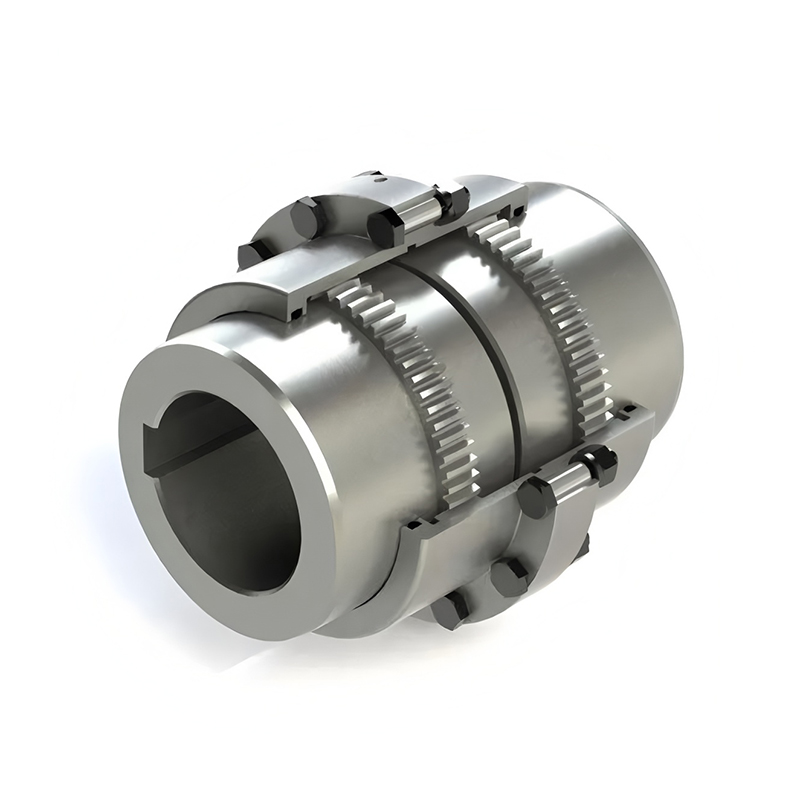 RSK-GICL Wide Drum Gear Coupling for High LoadsHigh-torque drum gear coupling that accommodates angular and radial displacement; suited to high-load, high-speed drives where lubrication and maintenance are acceptable.View Product →
Long Spans and Changing Angles Need a Shaft, Not a Coupling
When the distance between driver and driven machine is measured in metres, or when the working angle changes during operation, a short coupling cannot do the job. A single universal joint does not transmit constant velocity: output speed fluctuates twice per revolution, and the fluctuation grows with the joint angle. Two joints arranged so that both angles are equal and the yokes are phased correctly cancel that fluctuation, which is why a double-type cardan shaft is the normal choice for mill spindles, propeller shafts and heavy vehicle drivelines.
Keep both joint angles equal and as small as practical. A few degrees of difference between the two ends is enough to produce a torsional pulse that shows up as noise, wear and loose fasteners long before anything breaks.
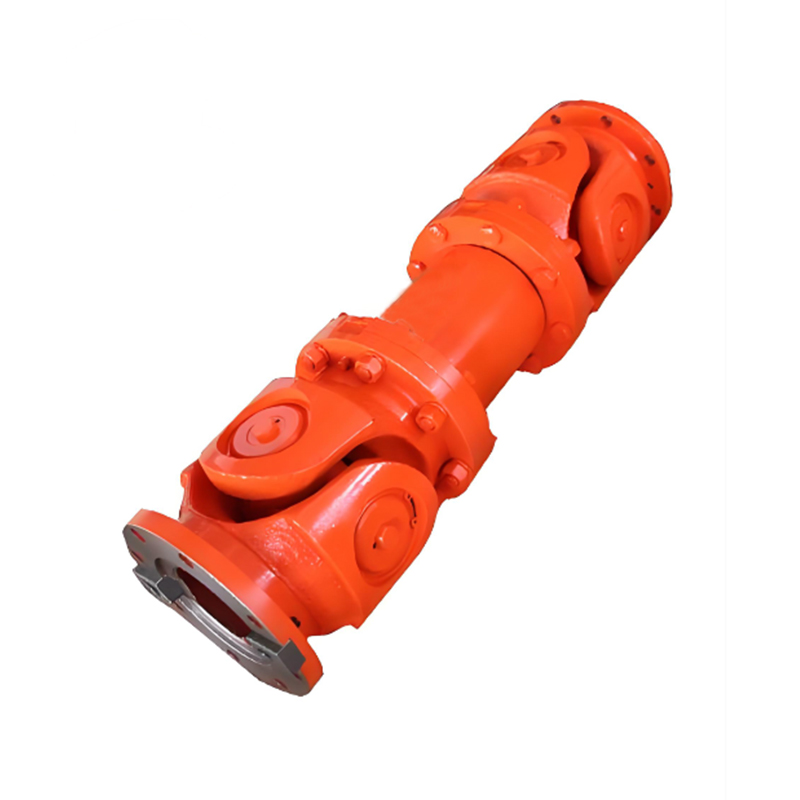 RSK-SWC BF Large Telescoping Flange Universal JointLarge-scale telescoping flange universal joint for high-load power transmission, compensating large angular misalignment with high efficiency and simple maintenance in harsh environments.View Product →
Servo Axes: Stiffness Beats Flexibility
On a servo axis the priorities invert. Torque is modest but positional accuracy is measured in arc-minutes, so the coupling needs high torsional stiffness, zero backlash and low inertia. Beam, bellows, diaphragm, jaw and cross-slider designs all appear here, and the differences matter: a bellows coupling adds stiffness, a jaw coupling adds damping, and an Oldham coupling solves a radial offset that the other designs cannot. For these axes, the flexible coupling range groups the five families by stiffness and misalignment so that the comparison stays inside one product family.
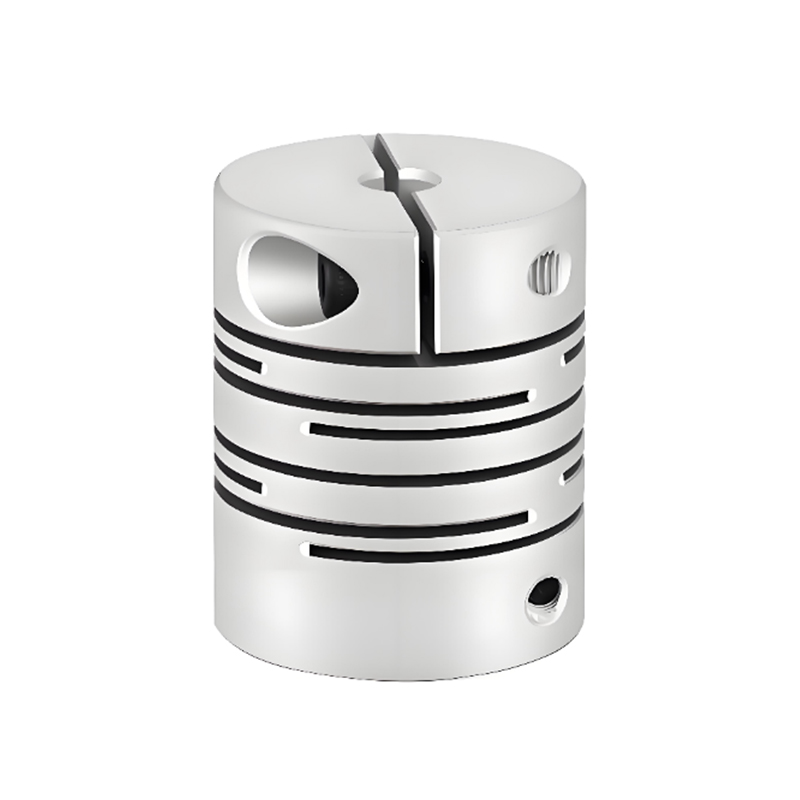 RSK-CPPC High Rigidity Aluminum Alloy Parallel Line Shaft CouplingHigh-rigidity aluminum beam coupling for servo and stepper motors, with gap-free clamping and compensation for radial, angular, and axial deviations.View Product →
Misalignment Is a Quantity, Not an Opinion
Suppliers publish maximum angular, radial and axial values. Treat those figures as limits under ideal conditions, not as a normal operating point. A workable field rule is to use no more than a quarter to a third of the rated angular capacity, because bearing reaction forces rise roughly in proportion to the angle, and the coupling is rarely the only flexible element in the train.
- Angular misalignment is measured between the two shaft centrelines over the coupling length. A 0.1 mm offset across a 100 mm span is already about 0.06 degrees.
- Radial or parallel offset is best absorbed by Oldham and tyre designs; gear and pin couplings tolerate only small values.
- Axial movement is often thermal. A 2 m steel shaft at a 60 °C rise above ambient grows by roughly 1.4 mm, which must be absorbed somewhere in the train.
- Check alignment after assembly, not before: re-measure once piping is connected and the machine has run hot at least once.
What to Send a Supplier
Vague enquiries produce safe, oversized couplings that cost more, weigh more and load the bearings harder. Send these eight points and the shortlist usually narrows to one or two types:
- Rated and peak torque, plus the service factor your application standard requires.
- Speed range, including any overspeed or run-up condition.
- Shaft diameters, keyway or clamp detail, and the required fit.
- Maximum angular, radial and axial misalignment expected after alignment.
- Shaft end separation, and whether the coupling must be removed for bearing service.
- Environment: temperature, oil, dust, washdown, salt spray, hazardous area.
- Balance grade and allowable residual unbalance, if the speed is high.
- Whether a brake wheel, brake disc or overload release is needed.
Procurement Risks Worth Checking
- Torque capacity is defined for a given fit and keyway. A clamp hub on a plain shaft and a keyed hub on the same shaft do not transmit the same load.
- Elastomer elements have a temperature ceiling. A coupling rated to 80 °C in a foundry running at 95 °C will harden and lose its damping within months.
- Interchangeability is a real risk: two couplings with identical bores and keyways can have different hub lengths, so spares may not fit the existing guard or spacer.
- The brake wheel's thermal capacity must match the stopping duty, not merely the coupling's torque rating.
- If the plant works to DIN or another named standard, ask for the drawing, material certificate and dynamic test record up front. A useful reference for type, standard and selection logic is the DIN coupling selection guide.
Jiangsu Rokang Heavy Industry Technology builds flexible drive components across most of the families above: ball-cage constant velocity joint couplings, cardan shafts, drum gear couplings, standard and high-speed diaphragm couplings, servo couplings, serpentine spring, tyre and marine high-elasticity couplings, plus locking assemblies for keyless shaft-hub connections. The company's products are exported to Europe, the United States, Russia, the Middle East and India, and the published application list covers cranes, metallurgy and rolling, mining, petrochemical, textile, military ships and rail vehicles.
Send the eight data points above with your enquiry, and the answer that comes back should be a type, a size and a drawing, not simply a price.