





 English
 русский
 中文简体
A crane hoist comes out of service after an inspector finds black grease weeping past the coupling guard. The planner orders a replacement "gear coupling" and then discovers the awkward part: the unit is a bolted two-sleeve design with crowned hub teeth, a spacer tube and a brake drum on one flange. That is four separate part references, not one.
Here is the conclusion up front: a gear coupling contains only a handful of parts, but the ones that wear are the ones hardest to describe without the original drawing. Order spares by dimensional and tooth data rather than by bore size alone, and treat seals, fasteners and lubricant as parts in their own right. The mechanics behind this are covered in more detail in our guide to how drum gear couplings behave in heavy industrial drives.
Content
The Part Groups Inside a Gear Coupling
Strip away the catalog language and a general-purpose gear coupling is a two-plane flexible joint built from a predictable set of components:
- Hubs — one per shaft, bored and keyed or shrink-fitted, with crowned external teeth cut on the outside diameter.
- Sleeves — flanged rings with internal teeth that mesh with the hub teeth; the two sleeves are bolted face to face.
- Flange fasteners — high-strength bolts and nuts, sometimes fitted bolts that carry torque through the joint rather than through friction alone.
- Seals and covers — O-rings, lip seals, end covers and gaskets that keep grease in and grit out.
- Lubricant and plugs — the grease or oil charge plus the filler and vent plugs that make relubrication possible.
- Optional elements — spacer tube or shaft, brake wheel or brake disc, nylon inner ring, end-float stops and balance weights on high-speed units.
Two practical consequences follow. The hubs and sleeves are the expensive items and normally the slowest to supply. The seals, plugs and bolts are cheap, and they decide whether the expensive items ever reach their design life. Our drum gear coupling range shows how the same basic part set is rearranged into narrow, wide and brake-mounted variants.
Tooth Geometry Is the Real Specification
The working surface is the tooth mesh. Hub teeth are crowned along the face width, and that curvature is what permits angular misalignment; the sleeve carries straight internal teeth in most industrial designs, with helical variants used where smoother meshing is wanted. Crowning radius, tooth count, pressure angle, backlash and flank hardness are all coupling-specific. Two hubs with identical bores and identical outside diameters can have completely different tooth geometry and will not interchange.
Misalignment capacity is quoted per mesh and is usually smaller than buyers expect — often only around a degree for continuous duty, with the crowned profile allowing short excursions beyond that. Because the mesh slides under load, it needs a lubricant film; a dry mesh wears quickly and produces the fine metallic paste that shows up in oil samples.
Inspection pays for itself here. Read the contact pattern first: bright bands in the middle of the face width indicate acceptable alignment, while heavy contact at the tooth ends points to misalignment, a sagging spacer or a soft base. Then measure backlash at the flange with a dial indicator. Record the figure at commissioning and use a doubling of that baseline as the trigger for a closer review; rising backlash with a clean contact pattern points to tooth thinning rather than to misalignment.
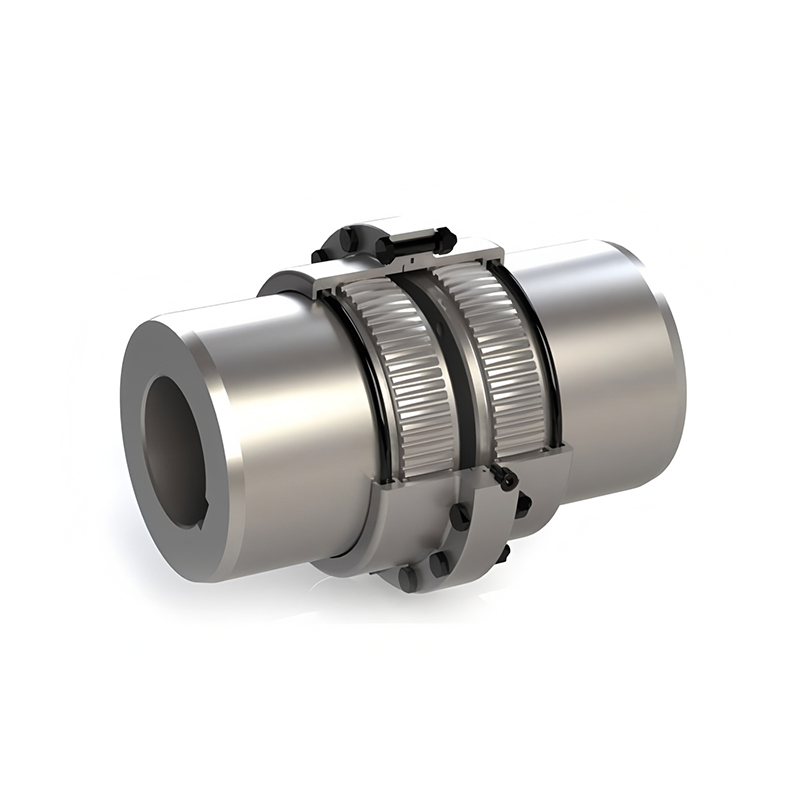 RSK-GIICL Narrow Crowned Gear CouplingNarrow-type crowned gear coupling for angular and radial misalignment; its lubrication and sealing needs make seal inspection relevant to avoiding grease loss.View Product →
Seals, Grease and the Service Life Nobody Budgets For
Gear couplings live on a film of grease or oil, and that film only survives if the seals hold. At speed, centrifugal action pushes lubricant outward against the O-rings, so a hardened, split or chemically swollen seal leaks steadily. Once grease escapes, abrasive dust enters, and the mesh starts lapping itself away. The failure looks like tooth wear but the root cause sits in a component costing a few dollars.
Three habits reduce that risk. Match the lubricant to the seal elastomer rather than to whatever drum is nearest the aisle, since some greases attack nitrile. Avoid over-filling high-speed units, where churning raises temperature and pushes lubricant past the seals. Finally, check vent and filler plugs at every inspection, because a blocked vent pressurises the housing and finds the weakest seal.
Sealed-for-life, grease-packed designs have their place on moderate-duty drives where relubrication access is poor. The trade-off is real: no maintenance interval, but less tolerance of high speed and high ambient temperature.
Spacers, Flange Fasteners and Brake Elements
Long spans between a motor and a gearbox, or across a machine bed, call for a spacer coupling: two flex planes joined by a tube or shaft and specified by the face-to-face dimension. The spacer is not a length of pipe. It transmits torque, has a balance quality and its flanges must seat flat, because a spacer that bows under its own weight loads the teeth unevenly at both ends.
Flange fasteners deserve their own line on the spares list. Fitted bolts locate the joint as well as clamp it, and reusing bolts with worn shanks or stretched threads is a common cause of loosening and fretting at the flange face. Keep bolt grade and torque values on file, and never mix grades across a joint.
Brake wheels and brake discs are common on crane hoists, conveyors and mill auxiliaries, where the coupling also has to stop the load. Diameter, runout, bolt pattern and the brake path all need to be specified together with the coupling, since the added mass changes balance and the mounting flange changes the torque path. Nylon inner-ring versions are a separate case again: the resilient element alters torsional behaviour and shock absorption, so it should be selected against the drive's excitation pattern, not swapped in as an upgrade.
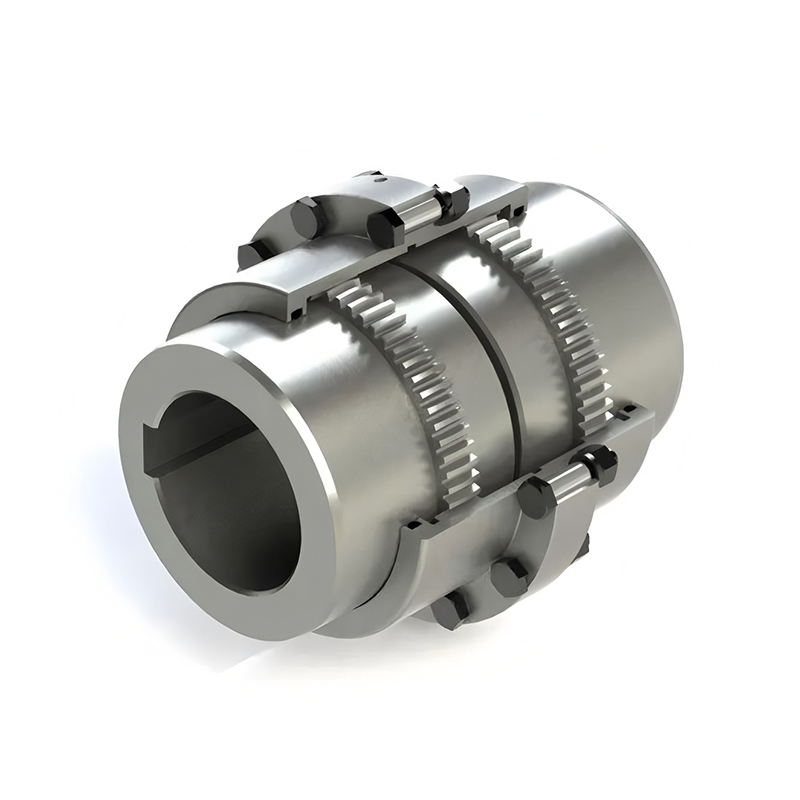 RSK-GICL Wide Drum Gear CouplingWide-type drum gear coupling for high load and torque transmission, with angular and radial displacement capability; lubrication and maintenance requirements should be confirmed at selection.View Product →
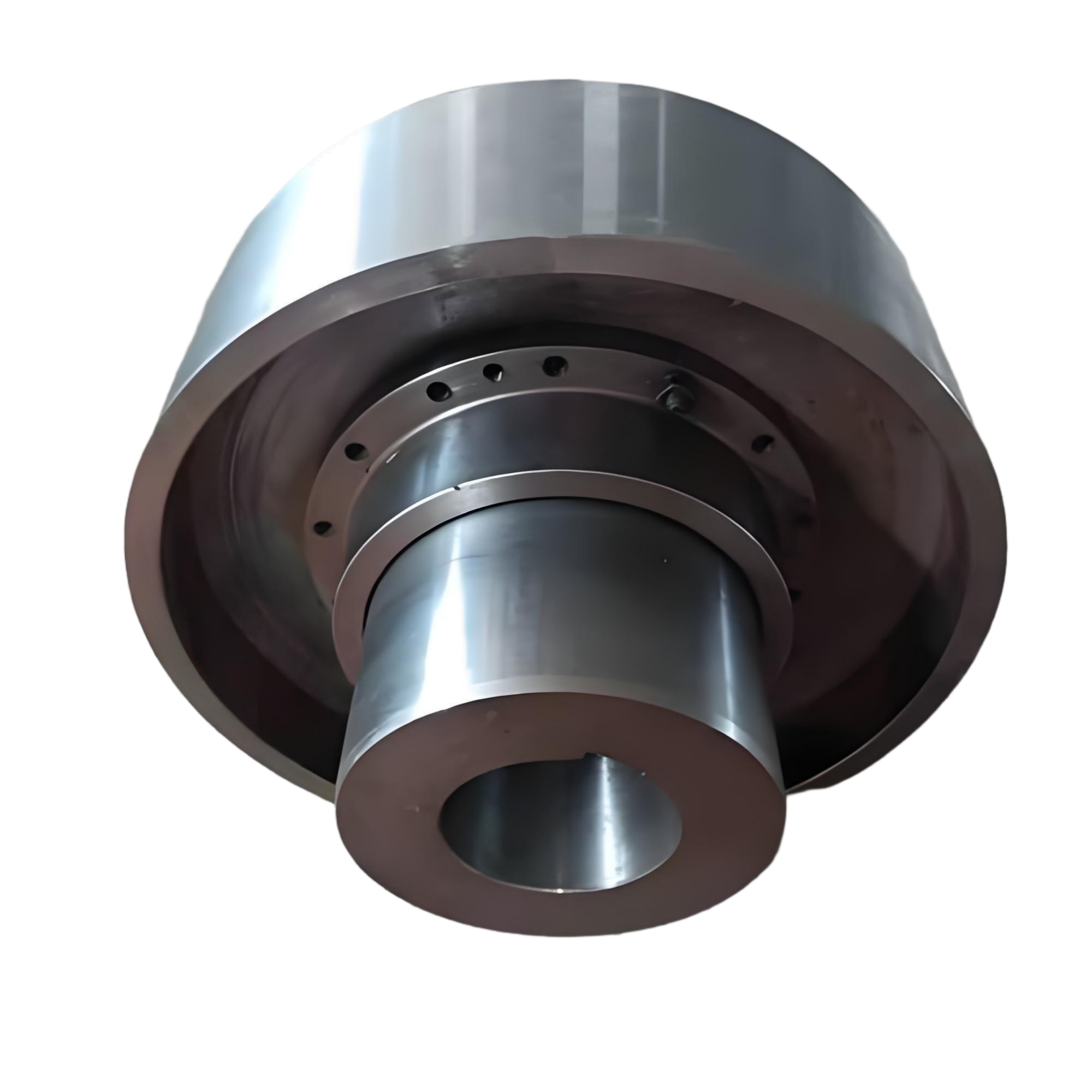 RSK-NGCL Drum Gear Coupling with Brake WheelIntegrated drum gear coupling with brake wheel for combined power transmission and braking; available in NGCL1–NGCL9 with torque ratings up to 14,000 N·m.View Product →
Part Groups at a Glance
| Part group | Function | Typical wear or failure mode | Data to record for spares |
|---|---|---|---|
| Hubs with crowned teeth | Connect shaft to mesh; allow angular misalignment | Flank wear, edge loading, spun or fretted bore | Bore, keyway, fit type, tooth count, crowning radius |
| Internally toothed sleeves | Close the mesh and transmit torque between flex planes | Tooth thinning, backlash growth, flange face damage | Sleeve type, flange bolt circle, backlash at build |
| Flange fasteners | Clamp and locate the joint | Loosening, stretched threads, worn fitted shanks | Bolt grade, size, torque value, fitted or clearance |
| Seals, covers, plugs | Retain lubricant, exclude contamination | Hardening, splitting, leakage, blocked vents | Elastomer type, profile size, plug thread |
| Spacer shaft or tube | Bridge long shaft separations | Bow, runout, balance loss, flange face fretting | Face-to-face length, tube diameter, balance quality |
| Brake wheel or disc | Provide a braking surface on the drive train | Runout, surface scoring, loosening at the flange | Diameter, thickness, bolt pattern, allowable runout |
What to Put on the Requisition
Most ordering errors are information errors. A clear inquiry carries the following:
- Coupling designation and drawing number, plus a photograph of the nameplate or the stamped sleeve face.
- Bore, keyway and fit type for each shaft, with measured values rather than nominal ones where the shaft has been reworked.
- Tooth data, or a pencil rubbing of the tooth profile when the drawing is lost.
- Face-to-face dimension, spacer length and brake element size, measured across the assembled joint.
- Duty data: continuous torque, peak torque, speed, expected misalignment and ambient temperature.
- Balance or speed class where the drive runs fast enough for it to matter, typically above a few thousand rpm.
Note also whether the coupling is oil-filled or grease-packed, since the seal kit and vent arrangement differ. If a nameplate is missing and the original maker is unknown, send the measured data plus a contact pattern photograph; a manufacturer working from real dimensions will usually identify the series faster than a search through old project files.
Repair, Replace or Investigate Further
Hubs and sleeves are matched sets and should be replaced as a pair when both show wear, because a new sleeve run against a worn hub will destroy its own tooth profile within weeks. A sleeve alone can be renewed when the hub flanks are clean and the backlash is still within the recorded baseline. If the bore itself is damaged by a spun fit or by fretting, the hub is scrap regardless of tooth condition.
The decision that saves the most money is the least popular one: if a coupling has failed twice within a year, the parts are rarely the problem. Look at alignment records, spacer sag, base stiffness and torsional excitation before ordering another set. Parts quality matters, but geometry and installation decide the outcome.