





 English
 русский
 中文简体
中文简体Content
- 1 The Three Failure Modes That Account for Most Gear Coupling Problems
- 2 How Lubrication Failure Progresses
- 3 Vibration Signatures That Point to a Coupling Problem
- 4 Early Warning Signs Before Catastrophic Failure
- 5 Reducing Failure Risk: Lubrication Standards & Alternative Designs
- 6 When to Consider a Different Coupling Type
The Three Failure Modes That Account for Most Gear Coupling Problems
Gear shaft couplings have transmitted heavy torque between misaligned shafts for over a century, and their failure patterns are well documented. Roughly 75% of known gear coupling failures trace back to improper lubrication, not a design flaw or a bad batch of steel. Misalignment accounts for another 20%, with the remaining share split between overload and fatigue.
That distribution matters because it changes where maintenance attention should go. A coupling that fails from lubrication starvation looks completely different under inspection than one that failed from chronic misalignment, even though both eventually produce the same symptom: a hub spinning freely inside a worn sleeve.
How Lubrication Failure Progresses
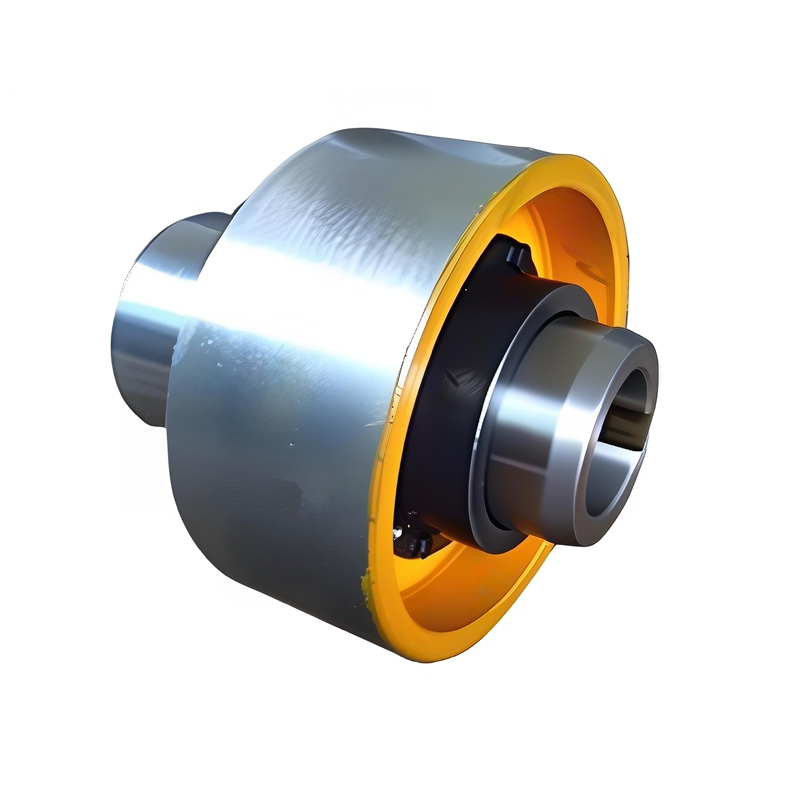
Gear coupling teeth rely on a grease film to prevent metal-to-metal contact as the teeth slide against each other to accommodate misalignment. When that film breaks down, either from grease that's aged past its service life or from contamination entering through a failed seal, the teeth begin to wear unevenly.
The progression is gradual and easy to miss. Backlash increases first, followed by tooth tip clearance widening as material wears away. Left unaddressed, the teeth thin to the point where they can no longer support the transmitted torque, and the hub rolls over inside the sleeve. This is the single most common terminal failure gear couplings experience, and it's almost entirely preventable with a scheduled relubrication interval. gear couplings built with crowned tooth profiles for better misalignment tolerance reduce the rate of this wear, but they don't eliminate the need for proper lubrication practice.
Vibration Signatures That Point to a Coupling Problem
Coupling defects produce distinctive vibration patterns well before a failure becomes visible on inspection. Recognizing the signature early is the difference between a scheduled repair and an unplanned shutdown.
| Vibration Signature | Likely Cause |
|---|---|
| Strong 2x and 3x running-speed harmonics | Worn or backlash-heavy gear teeth |
| Axial vibration exceeding 50% of radial | Misalignment transmitted through the coupling |
| Elevated vibration at coupling-adjacent bearings | Load imbalance from uneven tooth wear |
| Unusual resonance or overheating at bearings | Progressive coupling degradation |
None of these signatures alone confirms a coupling problem, since bearing wear and shaft imbalance can produce similar readings. But the combination of high axial vibration with a strong 2x harmonic is close to diagnostic for coupling-related issues specifically.
Early Warning Signs Before Catastrophic Failure
A broken coupling is obvious. The signs that precede it usually aren't, which is exactly why so many failures still catch maintenance teams off guard.
- Grease leaking visibly from the coupling guard, often the first sign of a failing seal well before tooth wear becomes serious
- Metallic particles appearing in grease samples during routine inspection, indicating active tooth wear already in progress
- Audible knocking or clicking that changes with load, suggesting backlash has grown beyond normal tolerance
- Overheating at the adjacent shaft bearings, often the downstream effect of a coupling no longer distributing load evenly
Any one of these on its own is worth a closer look. Two or more occurring together usually means the coupling is well into its failure progression and replacement should be scheduled rather than deferred.
Reducing Failure Risk: Lubrication Standards & Alternative Designs
Correct lubrication practice is documented in detail by the American Gear Manufacturers Association's technical standards for flexible coupling lubrication, which cover grease selection, oil-fill practices, and relubrication intervals for gear, chain, and grid couplings. Following those intervals is the single highest-leverage step in avoiding the most common failure mode outright.
Where lubrication management isn't practical, either due to access difficulty or continuous-duty operation that limits maintenance windows, a different coupling type may reduce risk more effectively than any maintenance schedule. diaphragm couplings that eliminate the lubrication failure mode entirely flex through a metal diaphragm rather than sliding gear teeth, removing wear-through-friction as a failure path altogether.
When to Consider a Different Coupling Type
Gear couplings remain the right choice where torque density and shock-load capacity matter more than maintenance simplicity, but that trade-off isn't universal. For hub connections that suffer repeated fretting corrosion from interference fits, locking assemblies that eliminate interference-fit fretting at the hub address one of the three documented failure paths directly.
For continuous-duty applications running at higher speeds where wear-free operation outweighs raw torque density, high-speed diaphragm couplings built for wear-free operation are worth evaluating against a gear coupling replacement. Where established alignment tolerances and standardized dimensions matter for interchangeability, DIN-standard couplings with established alignment tolerances offer a documented baseline to design against. And in applications where misalignment is a persistent, unavoidable condition rather than an installation error, serpentine spring couplings as a low-maintenance alternative tolerate that condition with less progressive wear than a standard gear coupling would.
 Previous