





 English
 русский
 中文简体
中文简体Content
- 1 How Coupling Gears Transmit Torque Between Misaligned Shafts
- 2 Straight-Tooth vs Crowned vs Drum-Shaped Gear Profiles
- 3 Matching Gear Coupling Type to Load and Misalignment
- 4 Coupling Gears with Integrated Braking Function
- 5 Lubrication Intervals and What Determines Service Life
- 6 When a Keyless Locking Assembly Outperforms a Keyed Connection
How Coupling Gears Transmit Torque Between Misaligned Shafts
Two hubs with external gear teeth, wrapped by a sleeve carrying matching internal teeth — that's the core geometry behind every coupling gear. Torque passes through the meshed teeth rather than a rigid bolted joint, and the clearance built into that mesh is what lets the coupling absorb misalignment without transmitting bending stress back into the connected shafts.
Three types of misalignment show up in real installations: angular, where shaft centerlines meet at an angle; parallel offset, where they run parallel but not coaxial; and axial, where shaft ends move closer or farther apart during operation. A well-matched coupling gear handles all three simultaneously, within limits that vary significantly by tooth profile — which is where selection decisions actually get made.
Straight-Tooth vs Crowned vs Drum-Shaped Gear Profiles
Straight-tooth couplings were the original design: teeth cut parallel to the shaft axis, contacting the mating sleeve along a flat face. They work, but flat-on-flat contact concentrates wear at the tooth edges once any angular misalignment is present, since the teeth can only rock slightly before edge loading sets in.
Crowned-tooth designs solve that by machining a slight radius into the tooth face, so contact stays centered even as the hub tilts relative to the sleeve. crowned gear coupling designs built for higher angular misalignment tolerance typically accommodate angular misalignment up to roughly 1°30′ per engagement, a meaningful jump over the fraction-of-a-degree tolerance straight teeth allow.
Drum-shaped (barrel) tooth profiles push this further, using a continuously curved tooth face rather than a single crown radius. That curvature spreads load across a wider contact area through the full range of misalignment, which matters most in applications where shock loading and vibration compound the effect of ordinary running misalignment — rolling mills and crushers being typical examples.
| Tooth Profile | Angular Misalignment (per mesh) | Typical Use Case |
|---|---|---|
| Straight tooth | Under 0.5° | Light duty, minimal misalignment |
| Crowned tooth | Up to ~1.5° | General industrial drives |
| Drum tooth | Up to ~1.5° with shock tolerance | Heavy, shock-loaded machinery |
Matching Gear Coupling Type to Load and Misalignment
Selection starts with two numbers: the torque the coupling must carry and the misalignment the installation will realistically produce. Neither should be estimated loosely — undersizing torque capacity accelerates tooth wear, while underestimating misalignment leads to premature edge loading regardless of how well the coupling is otherwise rated.
For applications combining moderate misalignment with shock or cyclic loading — conveyor drives, mixers, mill equipment — a nylon-sleeve or shock-absorbing design offers a meaningful advantage over solid steel construction. a nylon inner ring drum gear coupling designed for shock absorption reduces the peak load transmitted through the driveline during sudden torque spikes, which extends service life on equipment that starts and stops under load.
Where misalignment is minimal and the priority is torque density in a compact footprint, standard steel drum or crowned designs remain the more cost-effective choice — the added shock tolerance of a nylon sleeve isn't worth the tradeoff in torque capacity for steady, well-aligned drives.
Coupling Gears with Integrated Braking Function
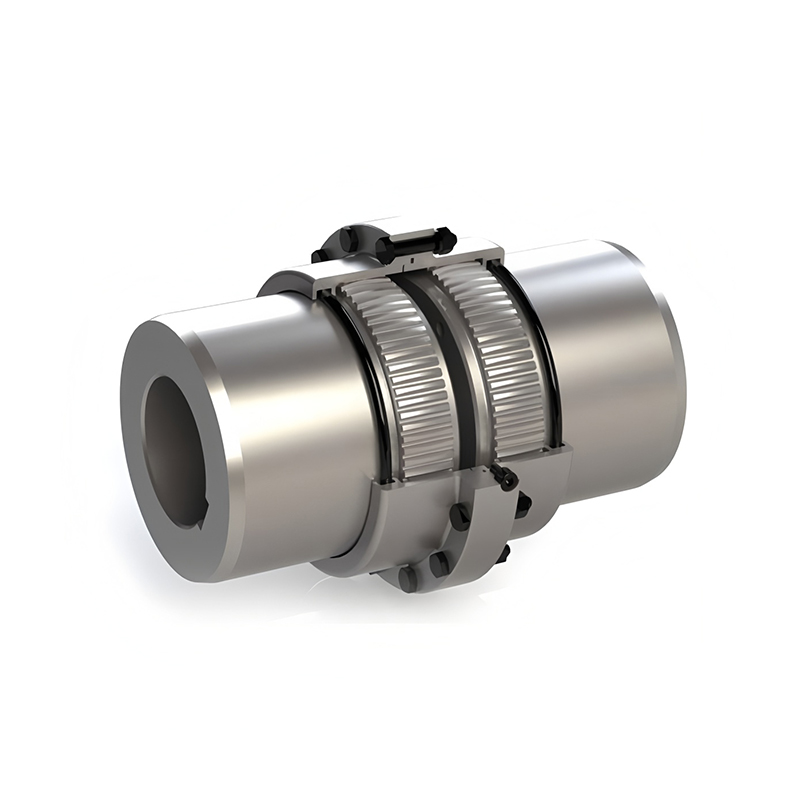
Cranes, hoists, and other applications requiring controlled stops need a coupling that doubles as a mounting point for braking hardware. Rather than adding a separate brake disc assembly downstream of the coupling, a drum-toothed design with a built-in brake wheel keeps the braking surface directly on the coupling body, shortening the drivetrain and eliminating an extra set of bearings and supports.
drum-toothed couplings built with an integrated brake wheel are common on overhead cranes and mine hoists specifically because the combined design reduces the number of separate rotating components that need independent alignment and inspection.
Lubrication Intervals and What Determines Service Life
Gear couplings fail from wear, not fatigue, and wear rate tracks almost directly with lubrication condition. Grease-lubricated couplings typically need regreasing on a schedule tied to operating speed and duty cycle — continuous high-speed service calls for shorter intervals than intermittent low-speed drives, and centrifugal force at higher RPM accelerates the separation of oil from thickener inside the grease itself.
Lubrication practices for gear-type couplings — lubricant selection, self-contained versus externally-supplied systems, and inspection intervals — are addressed in the ANSI/AGMA flexible coupling lubrication standard, which most manufacturers use as the baseline for their own maintenance recommendations.
In practice, a reasonable starting point for general industrial service is regreasing every six to twelve months, tightened to quarterly for high-speed or high-vibration installations. That interval should shift based on actual grease condition at inspection, not a fixed calendar — grease that shows metallic particles or has separated needs replacement regardless of how recently it was serviced.
When a Keyless Locking Assembly Outperforms a Keyed Connection
Traditional keyed shaft-hub connections work reliably at moderate torque, but the keyway itself introduces a stress concentration point and a small amount of backlash that grows as the key and keyway wear. On high-torque or reversing-load applications, that backlash eventually shows up as measurable play between shaft and hub.
A keyless connection clamps the hub to the shaft through friction alone, using a tapered locking element to generate uniform radial pressure around the full shaft circumference. keyless locking assemblies for backlash-free shaft-hub connections eliminate the stress riser a keyway creates and hold their grip without the incremental wear that keyed joints accumulate over repeated load cycles.
The tradeoff is cost and installation precision — keyless assemblies require more careful torque control during mounting than a keyed hub does. For applications where zero backlash and long-term holding power matter more than installation simplicity, that tradeoff is generally worth making.
For step-by-step guidance on getting alignment and mounting torque right the first time, step-by-step gear coupling installation and alignment procedures cover the sequence most installers miss when rushing a coupling swap.
 Previous