





 English
 русский
 中文简体
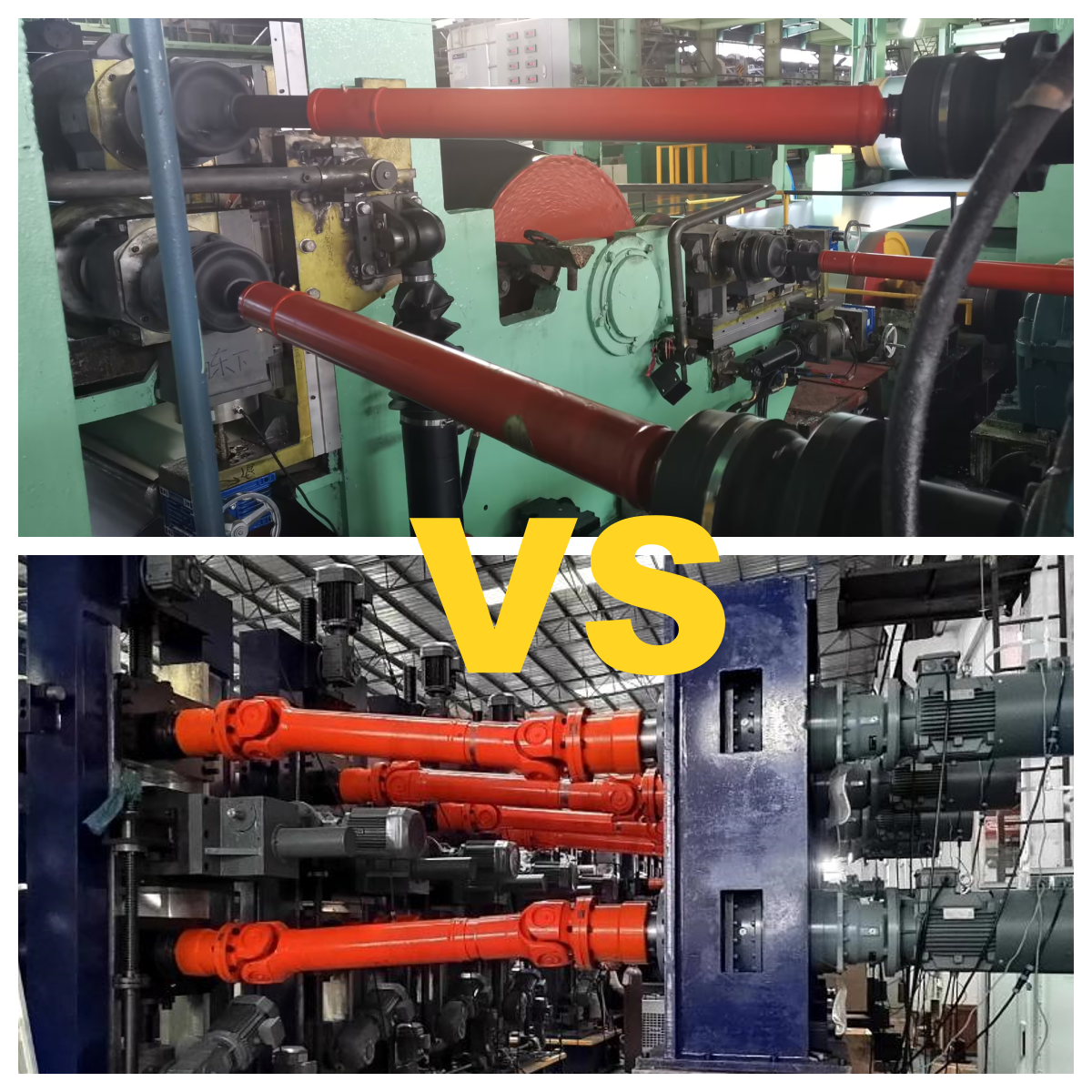
中文简体The core difference between industrial cross-shaft universal couplings and ball cage type constant-velocity universal couplings lies in transmission smoothness and applicable working conditions: the former has a simple structure, extremely high load capacity, but suffers from speed fluctuations, making it suitable for low-speed, heavy-load applications; the latter achieves strictly constant-velocity transmission with low vibration, making it suitable for high-speed, large-angle, and precision-drive scenarios.
Core Performance Comparison
* Constant-Velocity Characteristics and Smoothness
Ball cage type joint: Based on geometric principles, the force-transmitting points are always positioned on the bisecting plane of the angle between the two shafts, achieving perfect constant-velocity transmission. With machining errors, speed variation is less than 1%, effectively suppressing vibration and shock.
Cross-shaft joint: This is a non-constant-velocity universal joint. When the articulation angle is 20°, the driven-shaft speed variation can reach 7%, generating periodic alternating torque, which tends to cause vibration and additional loads.
* Transmission Efficiency and Power Loss
Ball cage type joint: Transmission efficiency is extremely high (approximately 0.98–1), and power loss increases only linearly and slightly with articulation angle.
Cross-shaft joint: Due to alternating torque, friction losses increase significantly as the angle increases, with notable efficiency loss at large angles.
* Operating Angle and Space Requirements
Ball cage type joint: Allows large articulation angles, typically in the range of 0–42.5°, with some designs reaching up to 75°. For the same rotational diameter, the installation size is more compact, and the minimum length is far shorter than that of the cross-shaft type.
Cross-shaft joint: The maximum practical articulation angle is generally limited to 25°, and in practice it is difficult to reach this limit. The structure is relatively bulky and occupies more space.
* Load Capacity and Durability
Cross-shaft joint: Simple and rigid structure, with extremely high load capacity under low-speed, ultra-high torque conditions. It withstands harsh environments well, and maintenance costs are low (only requiring replacement of bearings or the cross shaft).
Ball cage type joint: Although it also has strong load capacity, it is sensitive to contamination (requiring good sealing). The precision fit between the steel balls and raceways means it wears relatively quickly under overload or poor lubrication.
Key Parameter Comparison Table
| Dimension | Cross-shaft Universal Coupling | Ball-type Constant-Velocity Universal Coupling |
| Transmission characteristics | Non-constant-velocity (with speed fluctuations) | Perfectly constant-velocity (fluctuation <1%) |
| Maximum articulation angle | ≤25° (practical common use <15°) | 0–42.5° (extreme up to 75°) |
| Applicable rotational speed | Mainly low to medium speed | High-speed transmission |
| Maintenance requirements | Regular lubrication; wearing parts are inexpensive | High sealing requirements; overall replacement cost is high |
| Impact resistance | Extremely strong, suitable for heavy-load impact | Relatively strong, but precision components are vulnerable to contamination |
| Cost | Low (simple structure) | High (precision machining and complex heat treatment) |
* Selection Recommendations
Choose the cross-shaft type when the application involves heavy machinery, rolling mills, cranes, and other low-speed, high-torque, harsh-environment conditions where transmission smoothness is not a critical requirement.
Choose the ball-type joint when the application involves automotive drive axles, robot joints, precision machine tools, and other scenarios requiring high speed, large-angle deflection, low vibration, and high synchronization. If space is constrained and large-angle constant-velocity transmission is needed, the ball cage type joint is the only choice; if cost-effectiveness and heavy-load reliability are the top priorities, the cross-shaft type remains the industrial workhorse.
 Previous