





 English
 русский
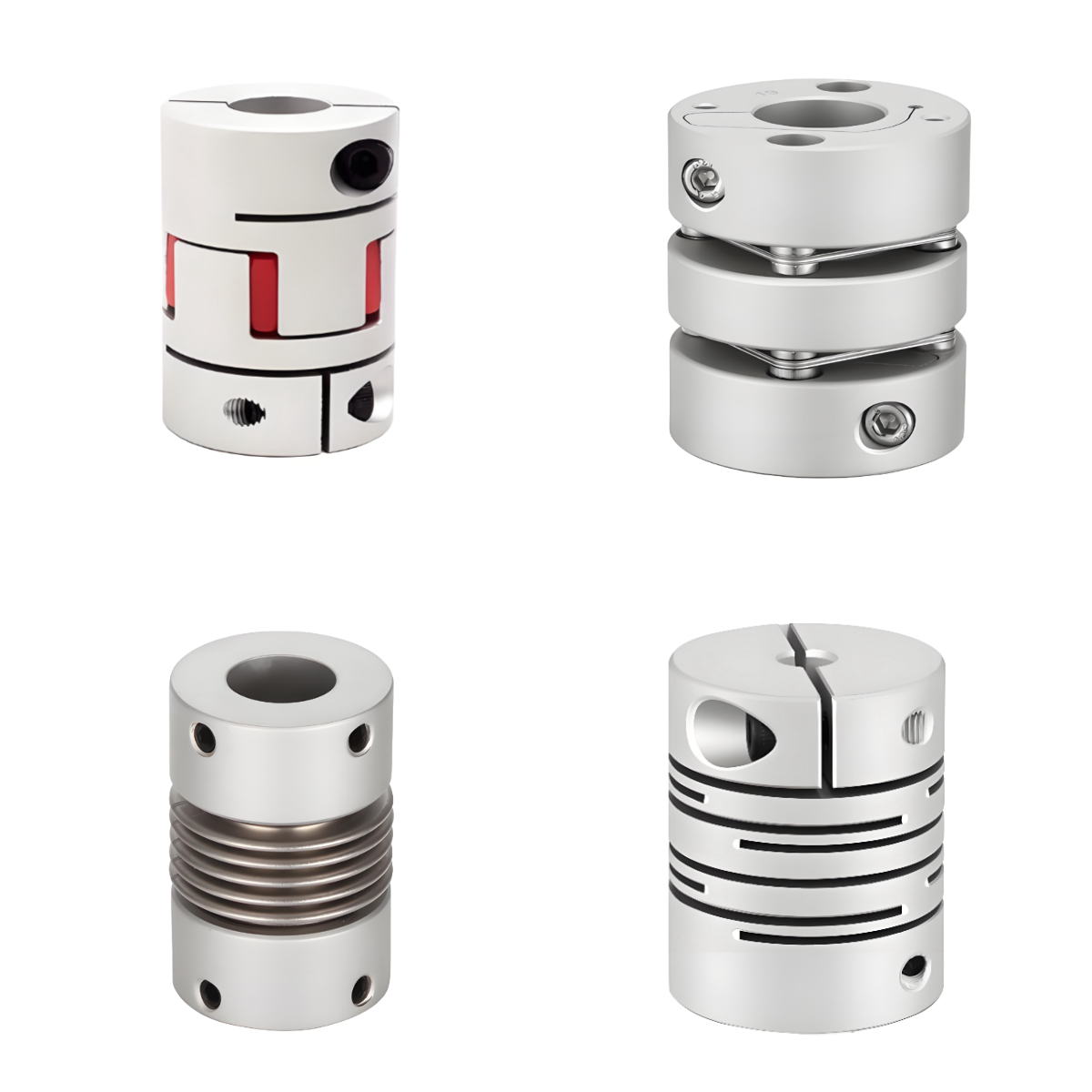
I. Curved-Jaw Coupling (also known as Spider Coupling)
Core Features: Metal jaw hubs +non-metallic blossom-shaped elastic element (e.g., polyurethane).
The elastic element is non-metallic, providing excellent buffering and vibration-damping capabilities, effectively absorbing shock and vibration.
Torsional stiffness is moderate, allowing slight elastic deformation, which results in some loss of transmission accuracy.
Misalignment Compensation: Excels at compensating for radial and angular misalignment, but has limited axial compensation capability.
Typical Applications: Medium-to-high-speed, small-to-medium power transmissions that require vibration damping and buffering, such as stepper motor drives and general machinery.
Advantages: Moderate cost, good damping, simple installation.
Disadvantages: Lower accuracy than all-metal couplings; the non-metallic elastic element is prone to aging under high temperatures or in oily environments.
II. Diaphragm Coupling
Core Features: Metal hubs + stainless steel metal diaphragms.
The elastic element is metallic, offering zero backlash, high torsional rigidity, and precise transmission of speed and torque.
Exceptional misalignment compensation: Effectively compensates for axial, radial, and angular misalignment while imposing minimal additional loads on bearings.
Damping capacity: Moderate; while it does provide some absorption, it is not as effective as non-metallic elastic elements.
Typical Applications: High-precision, high-speed, heavy-duty applications, or harsh environments involving high temperatures, oil, or corrosion.
Advantages: High accuracy, maintenance-free, high-temperature resistance, long service life.
Disadvantages: Relatively high cost; damping capacity is inferior to that of curved-jaw couplings.
III. Helical Beam Coupling (also known as Slit Coupling)
Core Features: Machined from a single piece of metal (aluminum alloy or stainless steel) with helical cuts.
High torsional rigidity, zero backlash (no clearance) for good precision.
Misalignment Compensation: Primarily compensates for angular and axial misalignment; has limited radial (parallel) misalignment compensation capability.
Damping: Very poor; almost no buffering effect, functioning as a rigid connection.
Typical Applications: Low-torque, high-precision positioning applications—commonly used to connect encoders, optical scales, and light-load lead screws.
Advantages: Simple structure, compact size, zero backlash, moderate cost.
Disadvantages: Requires high installation concentricity; cannot handle high torque; no damping.
IV. Bellows Coupling
Core Features: Metal hubs + thin-walled metal bellows (stainless steel).
The highest torsional stiffness among the four types, delivering exceptional transmission accuracy with zero backlash.
Good misalignment compensation: Compensates for axial, radial, and angular misalignment while maintaining uniform velocity transmission (no speed fluctuations).
Damping: Poor; almost no buffering effect, functioning as a rigid connection.
Typical Applications: Ultra-high-precision motion control systems, such as CNC machine tool spindles, precision positioning stages, and high-resolution encoder connections.
Advantages: Top-tier accuracy, excellent rigidity, fast dynamic response, long life.
Disadvantages: Relatively expensive; cannot handle heavy loads; no damping; the bellows section is relatively fragile.
Quick Selection Guide
If you need shock absorption and damping (e.g., high motor vibration) → Choose a Curved-Jaw Coupling.
If you need high precision in harsh environments (high temperature, oil, chemical exposure) → Choose a Diaphragm Coupling.
If you need light-load, high precision in a compact space (e.g., encoder connection) → Choose a Helical Beam Coupling.
If you need the highest precision and rigidity (e.g., CNC machines, positioning stages) → Choose a Bellows Coupling.
 Previous