





 English
 русский
A chain drive is a positive-engagement power transmission system that transfers mechanical energy between rotating shafts through the meshing of a chain with toothed wheels called sprockets. Unlike belt drives, which rely on friction, a chain drive provides a fixed speed ratio with zero slip.
However, selecting the right transmission method requires more than knowing how a chain works. This guide covers the fundamentals of chain drives, their practical strengths and limits, and a decision framework for choosing between a chain drive and direct shaft connections such as couplings and universal shafts.
Content
What Is a Chain Drive?
A chain drive consists of an endless chain wrapped around two or more sprockets. The driving sprocket rotates, pulling the chain, which then rotates the driven sprocket. Because the chain links physically engage with the sprocket teeth, the output speed is exactly proportional to the number of teeth on each sprocket. This is called positive engagement.
Core Components and Their Functions
- Chain links: The interconnected segments that form the flexible loop.
- Rollers: Cylindrical components that roll against the sprocket teeth, reducing friction and wear.
- Pins: The hardened steel rods that hold the links together.
- Bushings: Sleeves pressed over the pins that allow the rollers to rotate freely.
- Sprockets: Toothed wheels that mesh with the chain to transmit torque.
The fundamental difference from a belt drive lies in the mechanism: a belt transmits power through friction between the belt surface and the pulley, while a chain transmits power through mechanical interlocking. This distinction explains why chains maintain a constant speed ratio—a key advantage in many industrial processes where timing and synchronization are critical.
Main Types of Chain Drives Used in Industry
Although the basic operating principle is the same, different applications call for different chain designs. Industrial chains are typically classified by function:
- Power transmission chains: Designed to transfer power efficiently at moderate to high speeds. The roller chain is the most common type, used in applications from motorcycles to factory machinery.
- Conveyor chains: Built for moving materials, often at lower speeds with higher loads. They prioritize wear resistance and durability over speed.
- Hoisting chains: Used for lifting applications such as cranes and hoists. These chains are engineered for high tensile strength and safety under heavy loads.
Common Drive Chain Variants
| Chain Type | Typical Use |
|---|---|
| Roller chain | General power transmission; moderate loads and speeds |
| Engineered steel chain | Heavy-duty conveyors; abrasive environments |
| Welded steel chain | High-load conveying; low-speed, high-torque drives |
| Forged chain | Drag conveyors, bucket elevators; extreme wear resistance |
For higher torque applications, duplex chains (two parallel rows of links) or triplex chains are used. They provide a wider load-carrying surface without requiring a larger sprocket.
Key Advantages of Chain Drives
Chain drives remain a first-choice solution in many industrial contexts because they offer several performance characteristics that belts and gears cannot match simultaneously.
- No slip and constant speed ratio: The positive engagement ensures the driven shaft turns at an exact multiple of the driver speed, regardless of load variations.
- High efficiency: Well-lubricated chain drives achieve efficiencies around 97-98%, close to that of gear drives.
- Long center distances: Unlike gears, which require shafts to be close together, chains can transmit power over several meters with only a pair of sprockets.
- Multiple shaft drives: A single chain can drive several sprockets from one power source, simplifying machine design.
- Environmental tolerance: Metal chains withstand high temperatures, oil, grease, and moisture far better than rubber belts.
- Easy to adjust or replace: A chain can be shortened or extended by adding or removing links, allowing for simple length adjustments.
Limitations and Maintenance Considerations
No transmission method is universal. Chain drives come with inherent design constraints that engineers must factor into their selection.
- Noise and vibration: The metal-to-metal contact between rollers and sprockets generates sound and dynamic forces, especially at high speeds.
- Lubrication is mandatory: A dry chain wears rapidly. Regular oiling is required to control friction and prevent corrosion.
- Critical alignment requirement: The two sprockets must be kept parallel and coplanar. Chain drives cannot tolerate significant shaft misalignment without accelerated chain and sprocket wear.
- Limited speed range: At very high speeds (typically above 5,000-6,000 rpm for standard roller chains), the impact of chain articulation can lead to excessive wear and noise.
- Load limits: For extremely high torques, gear drives are generally more compact and more robust than chains of comparable size.
- Chain elongation (stretch): Normal wear causes the chain pins and bushings to polish and elongate. If not monitored, this leads to jumping teeth and sprocket damage.
The alignment limitation is particularly decisive in the selection process. When a two-shaft system cannot be held perpendicular to the centerline, or if vibration and thermal expansion cause the shafts to shift during operation, a chain drive will fail prematurely. This inherent weakness is exactly where a flexible coupling or a universal shaft becomes the more technically sound solution.
Chain Drive vs. Belt Drive vs. Coupling: When to Choose What
Each power transmission method occupies a distinct design niche. Here is a practical comparison to guide your decision.
Chain Drive vs. Belt Drive
Chains outperform belts in environments with high temperatures, oil, or chemical exposure, and where a precise speed ratio is non-negotiable. Belts, on the other hand, offer quieter operation, absorb shock loads naturally, and require no lubrication. For low-to-medium power with flexible speed requirements, belts are often simpler. For robust, precise, multi-shaft transmission, choose a chain.
Chain Drive vs. Shaft Couplings
The distinction here is more fundamental. A coupling connects two shafts directly, end-to-end, to transmit torque as a single unit. The decision hinges on the layout and alignment of your machinery:
- Use a chain drive when: the shafts are parallel but separated by a meaningful distance, or when you need to drive multiple shafts from one power source, and when you operate in a dirty, hot, or oily environment.
- Use a direct coupling when: the shafts are close together (often just a few centimeters apart), when you need to compensate for small amounts of axial, radial, or angular misalignment, and when the speed ratio is intentionally 1:1. This solution is simpler, compact, and maintenance-free compared to a chain and sprocket set.
- Use a universal shaft when: the shafts are not collinear and operate at an angle to each other. Chain drives cannot function with angular misalignment; a cardan shaft is engineered precisely for this condition.
Consider a common industrial scenario: a motor driving a gearbox where the axis of the motor and the input shaft of the gearbox are offset by a few millimeters. A chain drive would require a pair of sprockets and a tensioner, and would still be sensitive to any further misalignment. A flexible coupling mounted directly between the two shaft ends is the simpler, more reliable choice. Conversely, if the motor sits two meters away from the driven machine and also drives a secondary pump along the way, a chain drive is the only practical approach.
For applications with significant angular shaft displacement, precision universal shafts designed for large-angle torque transmission are the correct engineering solution—they handle angular misalignment that a chain cannot tolerate.
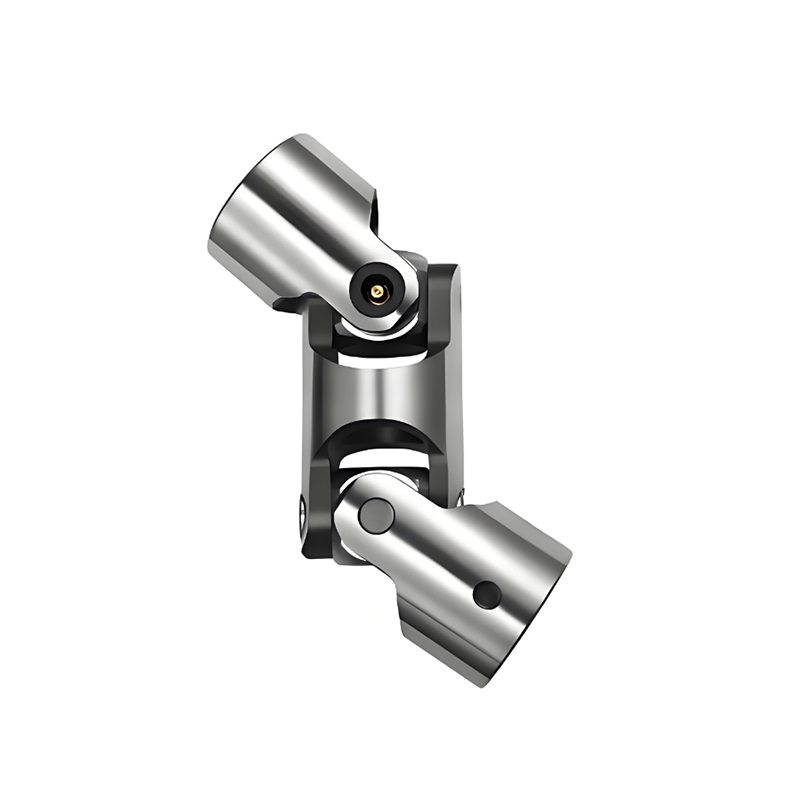 RSK-WS Precision Universal shaft Double type Large-Angle Torque Transmission SupJiangsu Rokang Heavy Industry Technology Co., Ltd is RSK-WS Precision Universal shaft Double type Large-Angle Torque Transmission Supplie...View Product →
In high-speed process machinery (such as centrifuges or test stands), chains add noise, require frequent lubrication, and their dynamic behavior becomes difficult to control. For couplings in the 3,000-10,000 rpm range, engineers commonly select customized high-speed diaphragm couplings rated up to 10,000 rpm to provide a stiff, balanced, and maintenance-free connection.
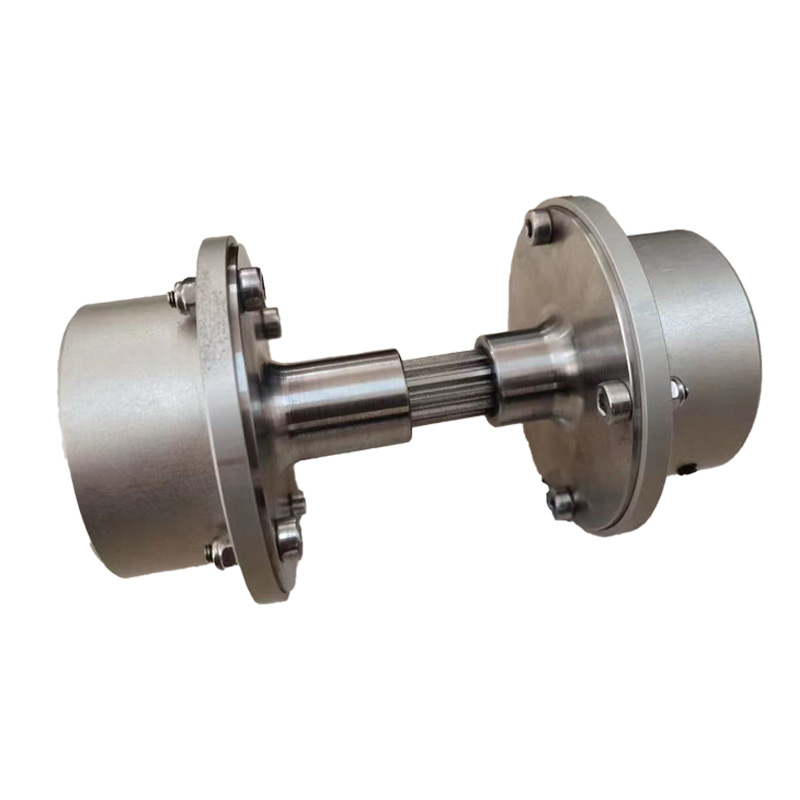 RSK customized high speed diaphragm coupling upto 10000rpm Suppliers, Company -Jiangsu Rokang Heavy Industry Technology Co., Ltd is RSK customized high speed diaphragm coupling upto 10000rpm Suppliers and Wholesale ...View Product →
How to Choose the Right Power Transmission Solution for Your Application
When faced with a transmission design, work through this sequence to narrow down your options:
- Check the center distance. If the two shafts are within a few diameters of each other (<2-3 times the sprocket diameter), a direct coupling is simpler and more compact. If the distance is large (over 1 meter), a chain drive or an intermediate shaft with couplings is needed.
- Assess alignment conditions. Can you guarantee and maintain parallel alignment? If yes, a chain drive is a valid option. If there is an angular offset or you cannot control alignment precisely, use a universal shaft or a flexible coupling.
- Determine speed and load. For high-speed operation (above 3,000 rpm) or where dynamic balance is critical, use a coupling instead of a chain. For moderate speeds and shock loads, a chain drive performs well.
- Evaluate the environment. Chips, dust, oil, and high temperatures wear out belts quickly but affect chains less. If the environment demands a lubricated open drive, chains are acceptable; if maintenance is minimal, choose a sealed coupling design.
- Consider the entire transmission system. Even when using a coupling, the shaft-hub connection plays a key role. For applications requiring high torque transmission without keyways and with precise positioning, high-torque shaft locking assemblies for precise positioning
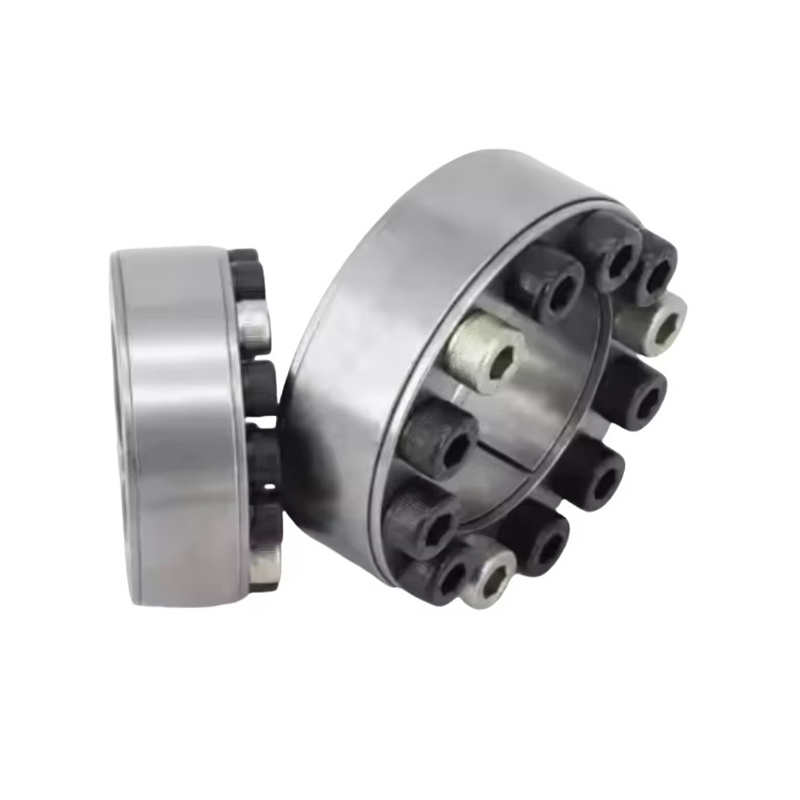 RSK-Z2 High Torque Transmission Expansion Sleeve for Complex Steel Loading with Jiangsu Rokang Heavy Industry Technology Co., Ltd is RSK-Z2 High Torque Transmission Expansion Sleeve for Complex Steel Loading with Easy...View Product → are excellent companions.
There is no single superior method. The correct choice emerges from a clear understanding of your machine's physical layout, speed, load, and operating conditions.
Conclusion
Chain drives are reliable, highly efficient, and well-suited for harsh environments and long-distance, multi-shaft transmission. Their key limitations—noise, the need for lubrication, and an intolerance for misalignment—point to where other methods should be considered. When the shaft distance is short, when misalignment must be accommodated, or when high-speed precision matters, flexible couplings and universal shafts become the superior engineering choice.
To deepen your understanding of coupling principles, you may find our guide to chain coupling working principles useful as a next step. For help selecting the right transmission component for your specific machine layout, our engineering team is available to discuss your requirements.
 Previous