





 English
 русский
 中文简体
中文简体A maintenance supervisor in a steel plate mill recently told us why he keeps three different flexible coupling types in his store: jaw couplings for the pump sets, a drum gear coupling for the main drive, and a spare diaphragm coupling for the high-speed blower. He chose them by what each shaft system actually does, not by habit. That is the right way to approach the subject.
Flexible coupling types are not interchangeable accessories. Each family trades compliance, torque capacity, speed, and maintenance needs against the others. This guide explains what makes a coupling flexible, compares the main elastomeric and metallic designs, and gives a practical selection path for real machinery.
Content
What Makes a Coupling Flexible?
A flexible coupling transmits torque between two shaft ends while allowing a controlled amount of relative movement. It must handle three kinds of misalignment: angular, where the shaft centerlines meet at an angle; parallel offset, where they are displaced sideways; and axial displacement, where thermal growth or thrust moves one shaft along its axis. It also filters vibration and cushions shock loads before they reach gears and bearings.
The engineering trade-off is consistent across every type: the more compliance a coupling offers, the more misalignment it absorbs, but the lower its torque density becomes. Elastomeric couplings let a rubber or polyurethane element do the flexing. Metallic couplings flex through gear teeth, steel discs, springs, or machined flexures and earn their place where torque, speed, or temperature push beyond what polymers can handle.
Flexible Coupling Types at a Glance
Most industrial specifications can be shortlisted from the types in the table below. Elastomeric designs are the first choice for general machinery; metallic designs dominate heavy, high-speed, and precision drives.
| Coupling type | Flexing element | Typical duty | Strength to remember |
|---|---|---|---|
| Jaw / spider | Elastomeric spider | Light to medium | Low cost, easy insert change, dampens vibration |
| Tire | Rubber body | Medium, shock-loaded | Largest misalignment capacity, no lubrication |
| Elastic pin | Elastomeric pins or bushes | Medium | Forgiving with pulsating loads, simple to maintain |
| Serpentine spring | Steel spring packs | Heavy shock | High torque with torsional damping |
| Gear | Lubricated gear teeth | Heavy, continuous | Highest torque density, proven in heavy industry |
| Diaphragm | Steel disc packs | High speed | Zero backlash, maintenance-free, excellent balance |
| Beam | Helical machined slot | Light precision | Monolithic, zero backlash, economical |
| Bellows | Thin-wall metal bellows | Light precision | Low inertia, high torsional stiffness |
Reading the table from the top: elastomeric types tolerate sloppy alignment and damp vibration, while metallic types carry heavier loads, survive harsher environments, and hold precision at the cost of tighter installation demands.
Elastomeric Couplings
An elastomeric coupling is attractive for one simple reason: when the rubber insert fails, you replace the insert, not the hubs, and the machine is back online quickly. Compression designs squeeze the elastomer between driving and driven members, while shear designs load the elastomer differently for softer torsional behavior.
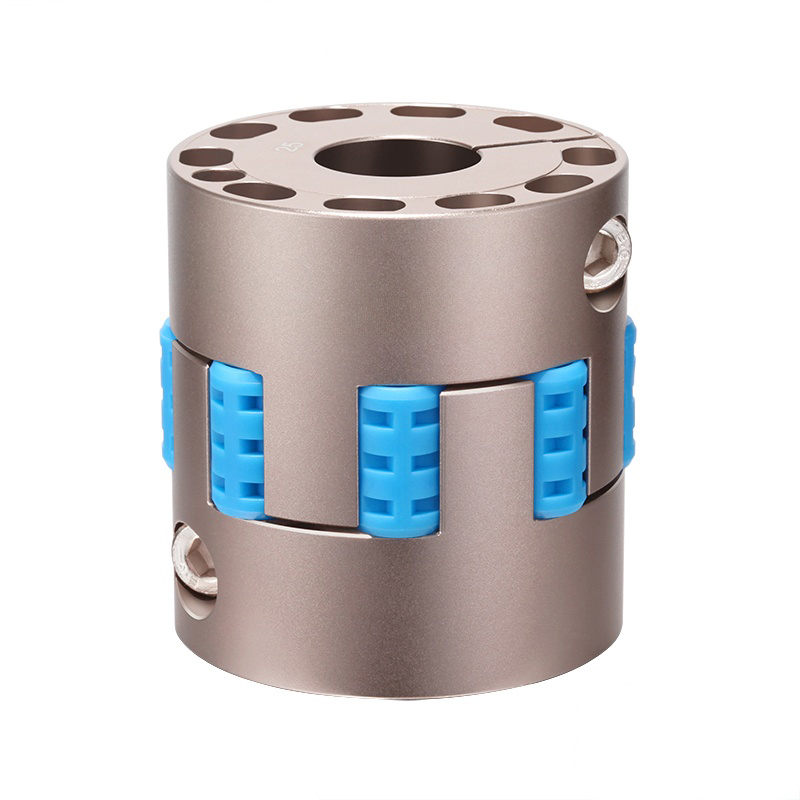 RSK-CPFJC Aluminum Alloy Jaw Coupling with Clamping Hub and Customizable BoresThis lightweight aluminum jaw coupling uses a polyurethane spider for zero-backlash, vibration-absorbing performance. Its clamping design simplifies installation, while the elastomeric insert handles moderate misalignment and shock, making it a cost-effective choice for pumps and conveying drives.View Product →
Jaw and spider couplings
The jaw coupling is the workhorse of the elastomeric family. Two metal hubs with curved jaws interlock, and an elastomeric spider fills the spaces between them. The spider works in compression, so the coupling tolerates moderate misalignment, dampens vibration, and protects connected components from shock. Spider compounds range from stiff polyurethane, which gives near-backlash performance for light positioning duty, to soft natural rubber, which absorbs heavy impact. For pumps, gearboxes, and conveying drives, jaw couplings are usually the lowest-cost reliable answer.
Tire couplings
A tire coupling uses a rubber element shaped like a tire, bolted to two flanges. It offers the largest misalignment capacity of any elastomeric design: angular, parallel, and axial offsets are all absorbed by the flexible body. It also provides strong torsional damping and needs no lubrication. The trade-offs are low torsional stiffness and a modest speed limit. Typical duties include diesel-generator sets, conveyors, mixers, and other shock-loaded low-speed machinery.
Elastic pin and pin-bush couplings
Elastic pin couplings transmit torque through pins fitted with elastomeric bushes or sleeves that seat into holes on the opposite flange. They are a standard choice for pump and fan trains because they forgive misalignment, cushion pulsation from reciprocating machines, and let you replace wearing pins without disturbing the shaft positions. They are simple to inspect and economical to maintain.
Serpentine spring couplings
The serpentine spring coupling wraps a continuous steel spring around the teeth of two hubs. Under load the spring deflects, which softens torsional shock and evens out torque peaks in heavy machinery. It combines high torque capacity with damping performance closer to an elastomeric design. Crushers, rolling mills, conveyors, and mobile equipment drivelines are common installations.
Metallic Flexible Couplings
Metallic couplings carry the load through steel components rather than polymer elements. They tolerate higher temperatures, oil, and chemicals, run at much higher speeds, and deliver higher torque for a given envelope. The price is stricter alignment and, in gear designs, scheduled lubrication.
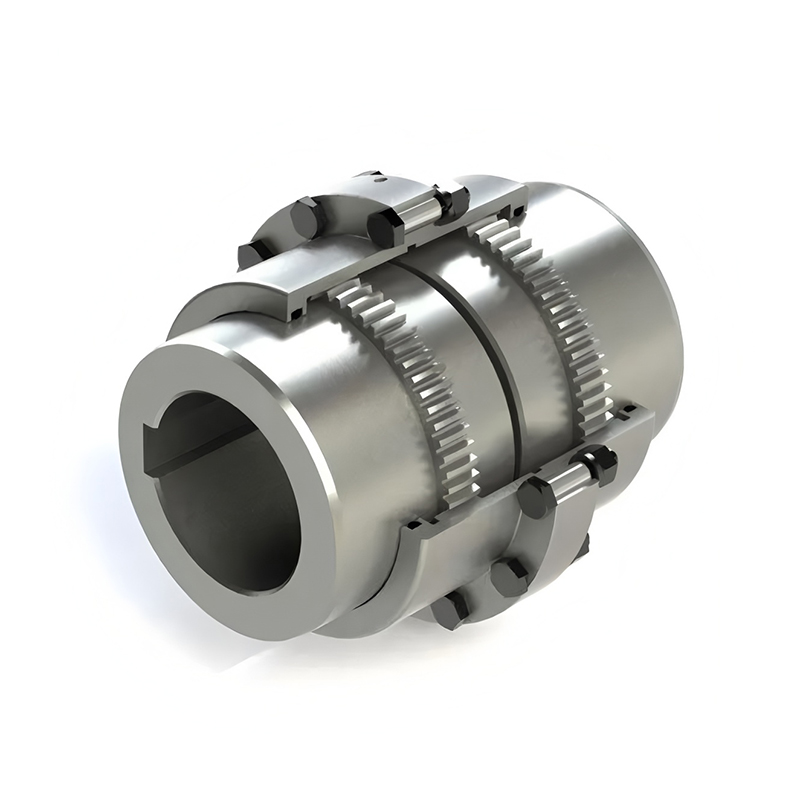 RSK-GICL Drum Gear Coupling with High Torque Capacity and Wide DesignFeaturing a drum-shaped tooth profile, this coupling allows significant angular and radial displacement while delivering high load capacity and torque transmission. It suits heavy-duty continuous drives such as mills and conveyors, though it requires lubrication and periodic inspection for reliable service.View Product →
Gear couplings
A gear coupling has two hubs with external gear teeth engaging an internal-toothed sleeve. The teeth transmit torque continuously while allowing angular and parallel misalignment through tooth clearance and crown shaping. It is the standard solution for heavy-duty continuous drives: rolling mills, crane travel drives, kilns, and large conveyors. Gear couplings deliver the highest torque density among flexible types, but they require lubrication and routine inspection. If you are sizing or replacing one, the technical details of drum gear coupling selection explain how rating, lubrication, and tooth form affect service life.
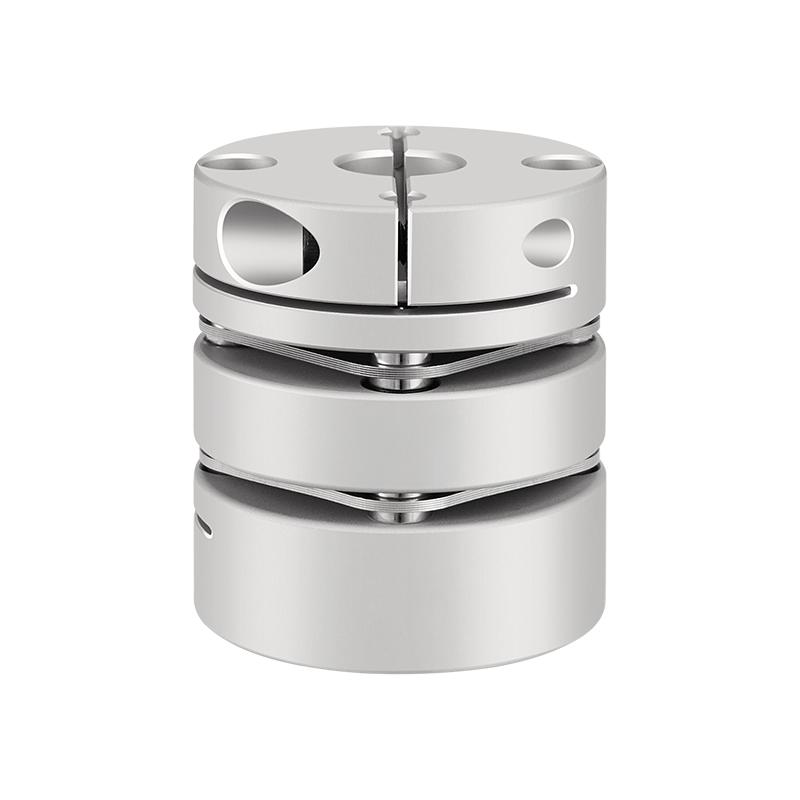 RSK-CPL Durable Diaphragm Disc Aluminum Alloy Coupling Clamp Type compensates for angular The shaft sleeve is made of high-strength aluminum alloyView Product →
Diaphragm couplings
A diaphragm coupling transmits torque through a pack of thin steel diaphragms that flex in bending. Because there are no sliding parts, no wear surfaces, and no backlash, it runs maintenance-free with excellent balance. These qualities make it the preferred choice for high-speed turbomachinery, test benches, compressors, and servo-driven equipment where positioning accuracy matters.
Beam and bellows couplings
Beam couplings are machined from a single piece of metal with a helical slot that creates a flexible beam. They are compact, zero-backlash, and inexpensive for small-diameter precision shafts, so they appear in encoders, stepper motors, and light positioning equipment. Bellows couplings use a thin corrugated metal bellows that flexes easily while remaining torsionally stiff; their low inertia and accurate torque transmission suit instrumentation and precision servo axes.
Choosing the Right Flexible Coupling
Selection starts with numbers and ends with operating conditions. Work through these five inputs in order:
- Torque with service factor. Peak torque, including starting torque, stall conditions, and shock events, must stay below the coupling rating.
- Misalignment. Determine angular, parallel, and axial offsets from the actual installation, not the drawing. Elastomeric types tolerate more; metallic precision types need tighter alignment.
- Speed and balance. Above roughly 1500 rpm, balancing and inertia matter. Diaphragm and high-speed metallic couplings cover the top end.
- Environment. High temperature, oil, ozone, and chemicals degrade elastomers. Metallic types are preferred in hot, oily, or solvent-laden areas.
- Maintenance policy. If uptime is critical, favor quick-replacement inserts or maintenance-free disc packs. If the site has a lubrication program, gear couplings become affordable.
No single coupling type wins everywhere. For pumps, fans, and light conveyors, a jaw or elastic pin coupling is usually the most economical choice. For heavy shock and high torque, gear and serpentine spring designs are the proven answer. For speed, precision, and zero maintenance, diaphragm, beam, and bellows couplings justify their higher price.
A final piece of practical advice: measure misalignment before you change coupling type. Many premature failures are caused not by the wrong flexible coupling type but by settlement, foundation wear, or thermal growth that has pushed shafts out of tolerance. Correct that first, then match the coupling to the duty, and you will get the service life the designer intended. If you want to compare standard and custom flexible couplings across these families, the complete product range is a good starting point.
 Previous