





 English
 русский
 中文简体
A gear coupling rarely fails with a bang. It fails with a wear step you can feel with a fingernail, a thin film of black paste weeping past a seal, or a sleeve that has started to run warm after a long shift. In most of the drives we see in rolling mills, cranes and crushers, the root cause traces back to three numbers that were never settled properly at commissioning: the grease grade, the fill quantity and the re-lubrication interval. Get those three right and a crowned-tooth coupling will usually outlast the machine it sits on. Get them wrong and no amount of vibration analysis will save the teeth.
Content
- 1 Why crowned gear teeth need a grease film at all
- 2 Grease or oil: let the enclosure decide
- 3 How much grease: the drain hole is the only gauge
- 4 Setting the interval from duty, not habit
- 5 A regreasing procedure that holds up on site
- 6 Reading the old grease
- 7 What lubrication cannot fix
- 8 What to write into the specification
Why crowned gear teeth need a grease film at all
A gear coupling transmits torque through external crowned teeth on each hub meshing with internal teeth in a floating sleeve. Under load, contact happens on a narrow band of tooth flank, and every rotation the sleeve slides slightly against the hubs as it compensates for angular, radial and axial offset. That sliding is intentional, but it is also the wear mechanism. A grease film separates the flanks, carries away heat and keeps water and grit out of the tooth chamber. Once the film breaks down, the failure sequence is predictable: polishing, then a wear step at the point of maximum misalignment, then increased backlash, then impact loading as the teeth slap instead of sliding. The same point applies across the drum gear coupling family used in heavy industrial drive systems, from crane hoists to mill pinion stands, which is why the lubrication clause deserves as much attention as the bore and torque rating.
Grease or oil: let the enclosure decide
Grease is the default for most general-purpose gear couplings because it stays where it is put and needs no level monitoring. Oil becomes the better answer when the coupling runs fast enough that grease churns, when radiant heat from a furnace or a kiln shell pushes the tooth chamber past the drop point of ordinary soap-thickened grease, or when the housing is oil-tight by design and shares a circuit with the gearbox. The mistake to avoid is choosing a lubricant that the seal arrangement cannot hold. A split sleeve with lip seals and a grease nipple is a grease coupling; forcing oil into it simply wets the floor.
| Item | Grease | Oil |
|---|---|---|
| Typical application | Standard and heavy-duty drives with lip or O-ring seals | High-speed, high-temperature or continuously loaded drives |
| Containment | Held by seals and centrifugal action; slight weeping is normal | Requires oil-tight housing, level plug and breather |
| Re-lubrication interval | Commonly 6 to 12 months, shorter in reversing or washdown duty | Change by sampling or scheduled drain, often 1 to 3 years |
| Main risk | Over-filling, seal damage, hardened grease from the wrong grade | Low level, water ingress, leaking seals |
| Field signature of trouble | Metallic sheen or rust in the purged grease | Dark oil, rising temperature, mist at the breather |
For a narrow-type unit running at moderate speed with combined angular and radial offset, a standard NLGI 2 grease with extreme-pressure additives is usually what the datasheet calls for. A product such as the GII CL crowned gear coupling illustrates the point: the seal design and the grease nipple position are part of the lubrication specification, not an afterthought.
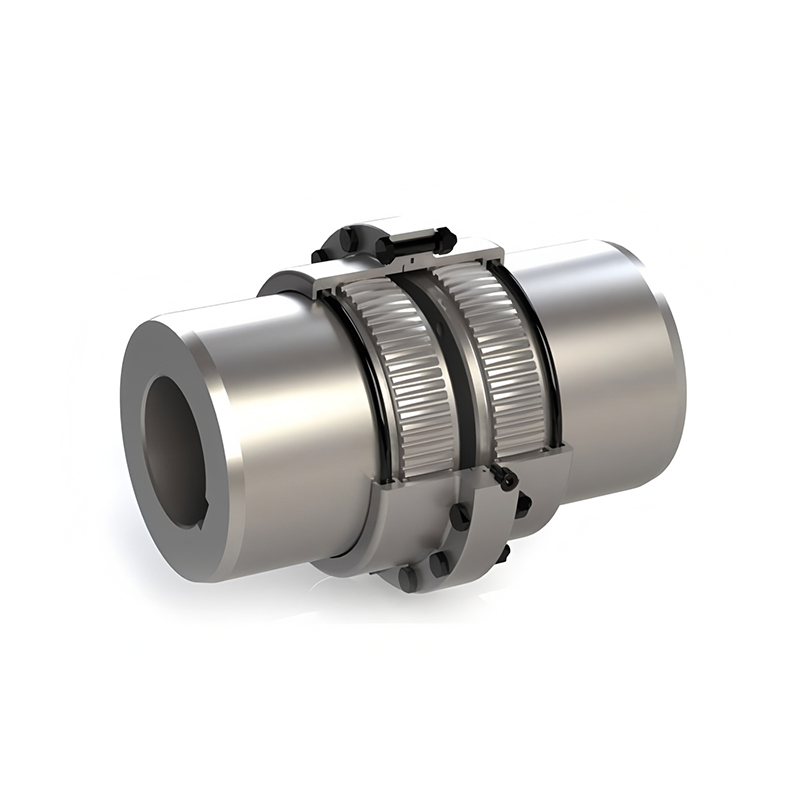 RSK-GIICL Narrow-Type Crowned Gear CouplingNarrow-type crowned gear coupling with high load capacity, misalignment compensation and lubrication requirements; worth reviewing for seal and grease-nipple details before setting fill procedures.View Product →
How much grease: the drain hole is the only gauge
Grease quantity is where most damage is done, in both directions. Too little and the outer teeth run dry at the point of maximum misalignment. Too much and the sleeve becomes a hydraulic press: pumping a chamber full of incompressible grease can push seals out of their grooves, load the sleeve axially and generate heat as the coupling churns a solid plug of lubricant. The practical rule is to fill until fresh grease appears at the open drain or relief hole, then stop. That gives you a full tooth chamber without pressurising the seals. Slow pumping matters here, ideally with a hand gun or a pump fitted with a pressure limiter, because a fast power gun can build pressure far above what a lip seal will take before the operator notices anything.
Heavy drives with large tooth chambers and long sleeves take proportionally more grease, and the fill point is easier to judge when the drain is genuinely open rather than partly blocked by old, hardened material. Wide-type bodies built for high load capacity, such as the RSK GICL wide drum gear coupling, reward a measured fill because the penalty for over-greasing a big chamber is a correspondingly big axial force on the shafts.
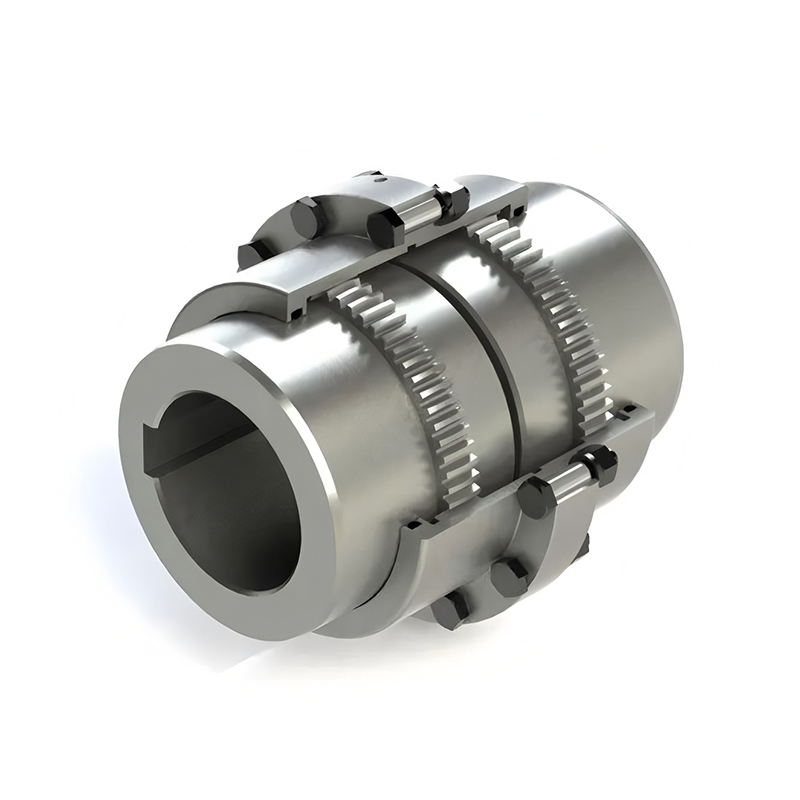 RSK-GICL Wide-Type Drum Gear CouplingWide drum gear coupling for high-load, high-torque transmission with significant angular and radial displacement; relevant when planning grease quantity and maintenance intervals for large chambers.View Product →
Setting the interval from duty, not habit
Six to twelve months is a reasonable starting point for a conventional grease-lubricated coupling, but that band is wide for a reason. Treat the manufacturer figure as a baseline and shorten it when any of the following applies:
- Reversing or high-cycle torque reversal, which wipes the film far more often than steady load.
- Ambient or radiant heat that approaches the base oil limit of the grease.
- Washdown, steam or humid tunnel conditions where water can enter past a seal.
- Vertical shafts, where any excess grease migrates toward the lower seal.
- Long shutdown periods, during which grease can channel and leave flanks unprotected at start-up.
A useful field method is to halve the recommended interval for the first year, purge a sample at each service and inspect it. If the grease comes out clean and still stringy, extend back toward the baseline. If it is dark, thin or gritty, investigate before adjusting anything.
A regreasing procedure that holds up on site
- Isolate and lock off the drive, and let the coupling cool enough that grease does not run straight off the teeth.
- Clean both the grease nipple and the drain plug before opening anything; grit introduced at this step is a common cause of premature wear.
- Remove the drain plug first, then the fill plug, so the chamber can vent as you pump.
- Identify the grease already in the coupling and avoid mixing incompatible thickeners, for example a lithium complex with a polyurea product.
- Pump slowly until fresh grease shows at the drain, then stop; do not chase a full chamber beyond that point.
- Refit the drain plug, release the gun, wipe the nipple and refit the fill plug.
- Record the date, grease grade, quantity used and which coupling was serviced, ideally on a tag at the machine as well as in the maintenance system.
- Run the drive and check for temperature rise or new noise within the first shift; both are early signals of over-fill or a dry flank.
Reading the old grease
The purged grease is a free diagnostic sample. Interpret it before you wipe it away:
- Metallic sheen or fine bronze-coloured particles: tooth flank wear, likely from misalignment or an over-extended interval.
- Milky or emulsified texture: water ingress through a damaged seal, washdown spray or condensation during idle periods.
- Hard, caked or varnish-like residue: the grease has been overheated, or the grade was wrong for the duty.
- Grease pushed out around the seal with no drain evidence: a blocked vent or chronic over-filling.
What lubrication cannot fix
Fresh grease will not correct permanent misalignment. Crowned teeth compensate a degree or so of angular offset per mesh and a small radial offset, but a shaft that sits outside the catalogue envelope will wear a step into the flanks regardless of lubricant quality. The same applies to unbalanced sleeves at speed, damaged seals that keep letting water in, and couplings already running with excessive backlash. At each regreasing, spend two minutes checking backlash by hand, looking for fretting dust around the sleeve joint and confirming that both hubs sit where the alignment record says they should. Those checks turn a lubrication task into actual condition monitoring.
What to write into the specification
Lubrication details are cheapest to settle before the coupling ships. Include the following in the enquiry and the purchase order:
- Lubricant grade, base oil viscosity and thickener type, plus the acceptable ambient range.
- Fill instruction stated as a volume or as fill-to-drain, with the drain position confirmed.
- Re-lubrication interval, and the maintenance access point: grease nipple, taper plug or remote line.
- Seal material matched to the site conditions, with a spare seal kit listed.
- Marking on the coupling itself showing grease grade and service date field.
Where the drive combines braking with transmission, the lubricant route must be agreed around the brake disc or drum rather than bolted on afterwards; a brake-wheel variant such as the RSK NGCL drum toothed coupling with brake wheel is a good example of why the access point belongs in the drawing review. The broader range of heavy-duty transmission products is listed on the manufacturer's gear coupling pages if you need to compare configurations.
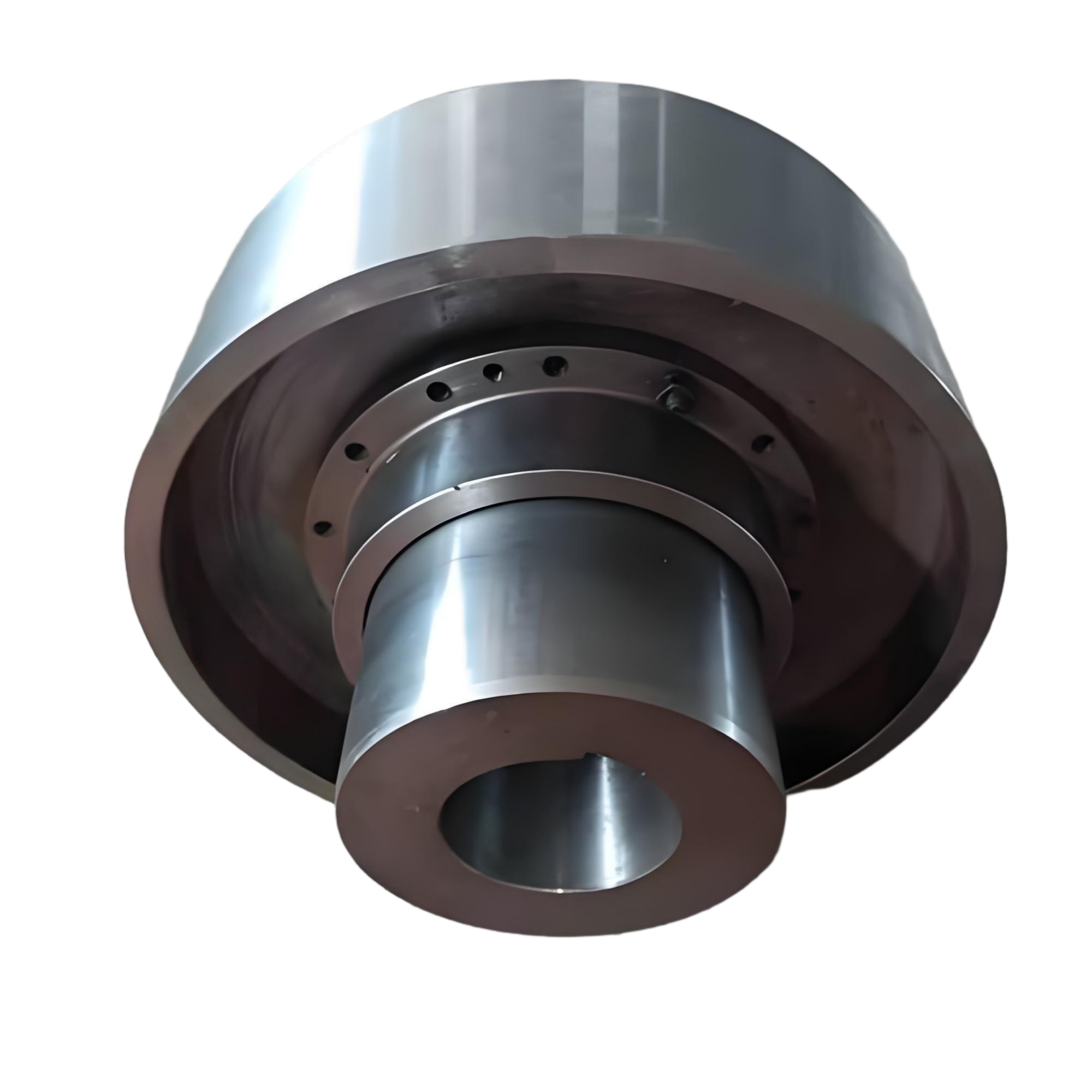 RSK-NGCL Drum Toothed Coupling with Brake WheelIntegrated drum-toothed coupling with brake wheel for combined power transmission and braking; worth reviewing for brake and lubrication access in compact drive layouts.View Product →
Gear coupling lubrication comes down to three decisions that should be made once and then audited: the right lubricant for the enclosure, the right quantity measured at the drain, and an interval that reflects the real duty. A coupling that is greased slowly, filled to the drain and checked for what comes out will usually show you a problem long before it becomes a shutdown. That is a considerably cheaper conversation than replacing a sleeve, two hubs and the downtime around them.
 Previous