





 English
 русский
 中文简体
中文简体Content
- 1 What a Shaft Coupling Actually Does
- 2 Rigid vs. Flexible Couplings: The Fundamental Split
- 3 Common Flexible Coupling Types and Where Each Fits
- 4 Specialized Couplings for Heavy-Duty and High-Speed Drives
- 5 How to Choose: Torque, Misalignment, and Speed
- 6 Installation and Maintenance Basics That Extend Coupling Life
What a Shaft Coupling Actually Does
A shaft coupling connects two rotating shafts end to end so torque and rotational motion pass from one to the other — typically from a motor to a pump, gearbox, compressor, or conveyor drive. That sounds simple, but the real engineering problem a coupling solves is almost never perfect alignment. Manufacturing tolerances, thermal expansion, foundation settling, and installation error mean the two shafts rarely sit in exact collinear alignment, and a coupling has to keep transmitting power smoothly despite that.
Beyond bridging misalignment, couplings also absorb shock loads and dampen torsional vibration before it reaches bearings and gearboxes downstream. A drive system without the right coupling wears out its bearings faster, runs noisier, and fails more unpredictably than one matched to a coupling built for its specific load and speed profile.
Rigid vs. Flexible Couplings: The Fundamental Split
Every coupling falls into one of two broad categories, and the choice between them comes down to one question: can the connected shafts be aligned precisely, and will they stay that way?
Rigid couplings lock two shafts into a single, solid connection with zero backlash. They deliver the most direct, efficient torque transfer possible, but they demand near-perfect alignment — any deviation puts stress straight onto bearings and shafts rather than absorbing it. This makes rigid couplings the right call for precision equipment like CNC spindles and stepper motor drives, where alignment is tightly controlled from the start.
Flexible couplings trade a small amount of transmission efficiency for the ability to accommodate angular, parallel, and axial misalignment while damping vibration. This is the category most industrial drivetrains actually need, since perfect alignment is rarely achievable — or affordable to maintain — outside a lab setting.
Common Flexible Coupling Types and Where Each Fits
Within the flexible category, different designs solve different combinations of torque, misalignment, and speed requirements.
Gear couplings transmit torque through interlocking crowned teeth on a spool or sleeve, which lets them handle high torque and significant misalignment at the same time. They remain a default choice in heavy industrial drives — steel mills, mining conveyors, marine propulsion — where gear couplings built for high torque industrial drives need to survive both continuous load and periodic shock without failing at the teeth. For a closer look at how the different gear coupling profiles compare, our in-depth breakdown of high-performance gear coupling design covers drum versus crowned tooth geometry and when each is specified.
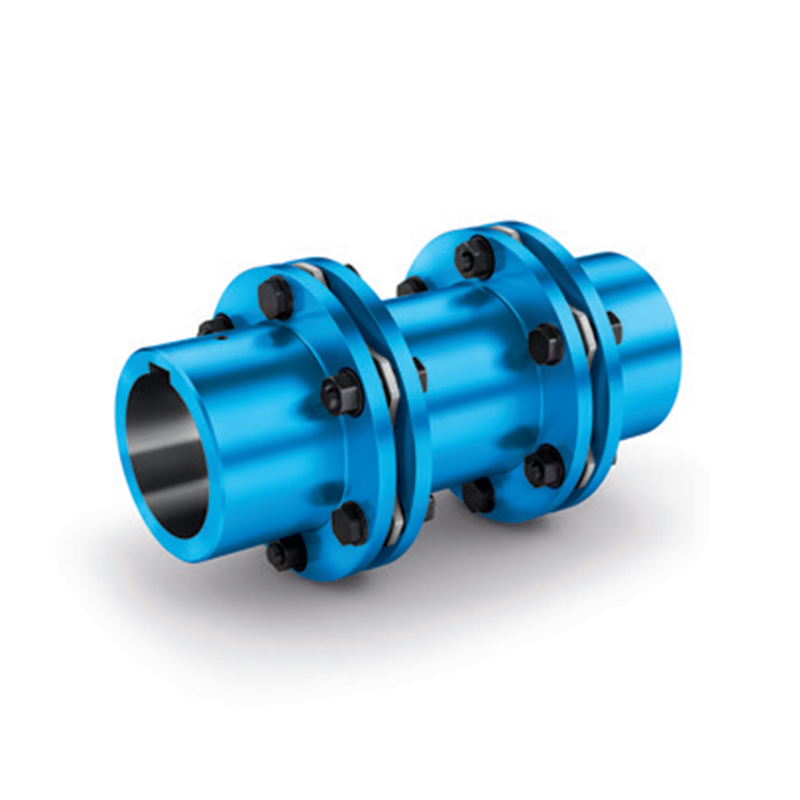
Diaphragm couplings use a thin flexing disc or membrane instead of teeth, eliminating metal-to-metal sliding contact entirely. That means no lubrication and no wear from relative motion between parts, which is why diaphragm couplings for precision servo applications show up in CNC machinery and other clean, maintenance-averse environments where downtime for relubrication isn't an option.
Jaw and spider couplings use two hubs with interlocking jaws separated by an elastomer insert, which absorbs shock and provides some electrical isolation between the connected shafts. Jaw spider couplings with a replaceable elastomer insert are common on servo and stepper motor drives, where the insert can be swapped without disturbing shaft alignment when it eventually wears.
Specialized Couplings for Heavy-Duty and High-Speed Drives
Some applications push past what a standard elastomeric or gear coupling can handle, which is where more specialized designs come in.
Serpentine spring couplings route a continuous curved spring element between grooved hubs, giving them exceptional shock absorption without the backlash that plagues jaw-type designs under reversing loads. Serpentine spring couplings built for shock-heavy drivelines hold up well in applications with frequent starts, stops, and load reversals — mining equipment and military vehicle drivetrains among them.
DIN-standard couplings follow European dimensional and performance standards, which matters when equipment needs to interface with machinery built to that spec or when a project simply requires standardized, interchangeable parts. DIN-standard couplings for European-spec equipment cover everything from torsionally rigid gear designs to flexible types built for high-speed drives.
Cardan shafts and universal joints solve a different problem — transmitting power across a distance or through an angle rather than simply joining two shaft ends. Cardan shaft assemblies for long-distance or angled power transmission are the standard solution when the driving and driven equipment aren't sitting in a straight line, which is common in rolling mills and heavy processing equipment.
How to Choose: Torque, Misalignment, and Speed
Selecting the right coupling comes down to matching three variables to the application, in roughly this order of importance.
| Priority | Question to Answer | Coupling Types to Consider |
|---|---|---|
| Torque | What's the continuous and peak torque load? | High torque: gear, serpentine spring. Low-moderate: jaw, beam, oldham |
| Misalignment | How much angular, parallel, or axial offset is expected? | Higher tolerance: gear, chain, tire. Precision alignment: diaphragm, disc |
| Speed | Is this a low-speed heavy drive or high-RPM precision equipment? | High speed: diaphragm, gear. Lower speed, high shock: serpentine spring, elastomeric |
Torque capacity should rule out unsuitable options first, since undersizing a coupling on torque leads to outright failure rather than gradual wear. Misalignment tolerance narrows the field further, and speed rating is usually the final filter — a coupling rated correctly for torque and misalignment can still fail from imbalance-induced vibration if it's pushed beyond its speed rating. Industry specification for flexible couplings is largely governed by AGMA standards covering balance classification and bore/keyway fits, and this engineering overview of specifying flexible couplings walks through how those standards apply in practice.
Installation and Maintenance Basics That Extend Coupling Life
Even the correctly specified coupling underperforms if it's installed or maintained poorly. Shaft alignment should be checked and corrected before final tightening, since a flexible coupling compensating for avoidable misalignment burns through its service life faster than one working within its designed tolerance. Periodic inspection for wear at elastomer inserts, gear teeth, or spring elements catches degradation before it turns into unplanned downtime, and any coupling type rated for lubrication needs that lubrication maintained on schedule rather than skipped.
Getting these fundamentals right is what lets a coupling deliver the functional benefits couplings bring to a drive system — stable torque transmission, reduced bearing wear, and longer intervals between maintenance — for the length of its rated service life rather than falling short of it.
 Previous